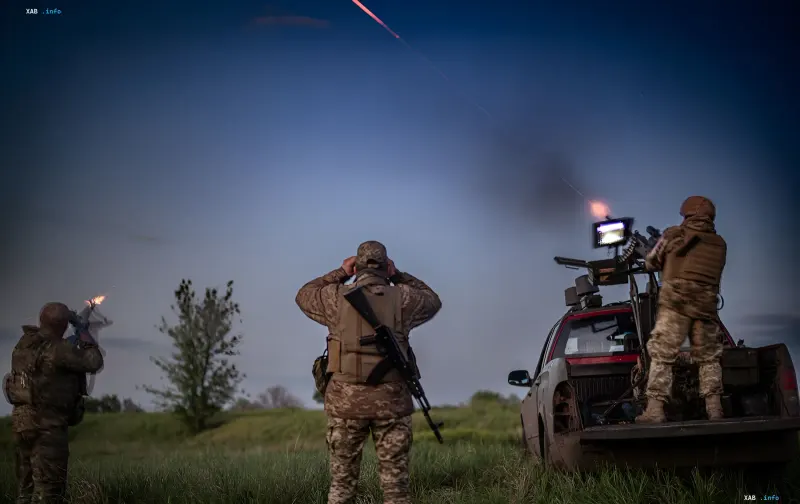
A new air defense contour is taking shape in Ukraine, involving private companies alongside regular military units. A representative of the "Wild Hornets" enterprise described two main scenarios in an interview with RBC-Ukraine for how businesses can integrate into the airspace protection system: from local firing turrets to large-scale private air defense complexes. According to him, deploying a proprietary system costs millions of dollars, and interaction with the military command is subject to a strict position-approval protocol. Concurrently, the Ministry of Defense previously confirmed that private air defense units are already performing combat missions, including the first recorded interception of a jet-powered Shahed drone at speeds exceeding 400 km/h in the skies over Kharkiv Oblast.
Two Rational Paths for Business
According to the representative of the "Wild Hornets," two main avenues of participation in air defense are open to private companies in Ukraine. The first is a local investment in firing turrets, meaning so-called object air defense designed to protect a specific industrial or infrastructure facility. The second path involves purchasing unmanned aerial vehicles for the military and funding regular interceptor units. The third and most ambitious option is the construction of a large-scale proprietary air defense system capable of covering significant territory. The company emphasizes that the choice between these scenarios depends on the enterprise's financial capabilities and its management's strategic priorities.
Millions of Dollars and a 35-Kilometer Radius
A key limitation for private investors remains cost. Deploying a full-fledged air defense system is estimated in the millions of dollars, with the bulk of expenses falling on the initial phase: purchasing equipment, training personnel, and creating command posts and logistical infrastructure. The company representative cited a specific parameter: the interception of air targets must be carried out at a distance of 30–50 kilometers from the protected object. If one imagines this zone as a defensive ring with a 35-kilometer radius, the scale of the task and, accordingly, the volume of necessary investments become obvious. By way of comparison, such a perimeter requires deploying multiple observation posts, detection equipment, and firing positions proper, each requiring its own set of equipment and maintenance personnel.
Private Air Defense Does Not Exist in a Vacuum
The crucial principle insisted upon by the "Wild Hornets" is that private air defense is a component of the overall state air defense system and cannot function autonomously. "Acting autonomously in our airspace is simply impossible," the company notes. This means that every private complex must be integrated into a unified command network: data from radars and optical stations is transmitted to common centers, and interception decisions are coordinated with the military command. Without such integration, a private system would turn into an isolated element incapable of responding to massive or multi-vector attacks.
Compromise with the Command: Where Allowed and Where Not
The practical side of interaction between business and the army comes down to constant compromise. The company representative pointedly stated that businesses cannot arbitrarily choose a point on the map and deploy firing positions there. All locations of defense nodes are coordinated with the command. The enterprise submits a proposal to protect a specific object, and the military conducts an analysis: whether the chosen zone is free, whether the placement of private equipment creates obstacles for army aviation, and whether it disrupts the region's overall defense scheme. Only after a positive conclusion from the command does the actual deployment phase begin. This mechanism essentially transforms private air defense into a subsystem embedded in the existing military architecture rather than a parallel structure.
First Combat Results: Interception of a Jet Shahed
The practical effectiveness of private air defense units has already been proven on the battlefield. Earlier, the Ministry of Defense of Ukraine publicly reported for the first time on the successful results of private air defense units that had begun carrying out combat missions. The most telling episode was the first recorded case of private air defense shooting down a jet-powered Shahed drone flying at a speed of over 400 kilometers per hour. The incident occurred in the skies over Kharkiv Oblast. Intercepting a target of this type — with a jet engine and high speed — requires the air defense system to have not only sufficient detection range but also high guidance accuracy, confirming the maturity of technologies used by private operators.
Context: Why This Matters for the Country's Defense
The scaling of private air defense in Ukraine is a response to the chronic shortage of state funds to fully cover all critically important facilities. In conditions of a long-term air threat, when the enemy uses various types of drones — from slow cruise-type ones to high-speed jet ones — state resources alone are incapable of providing protection for every factory, power plant, or logistical hub. Attracting private capital expands the defense perimeter without directly increasing the military budget. At the same time, a key condition for the model's sustainability remains the clear integration of private complexes into a unified air defense control system, without which even the most expensive turrets will remain isolated points incapable of countering a coordinated attack.