
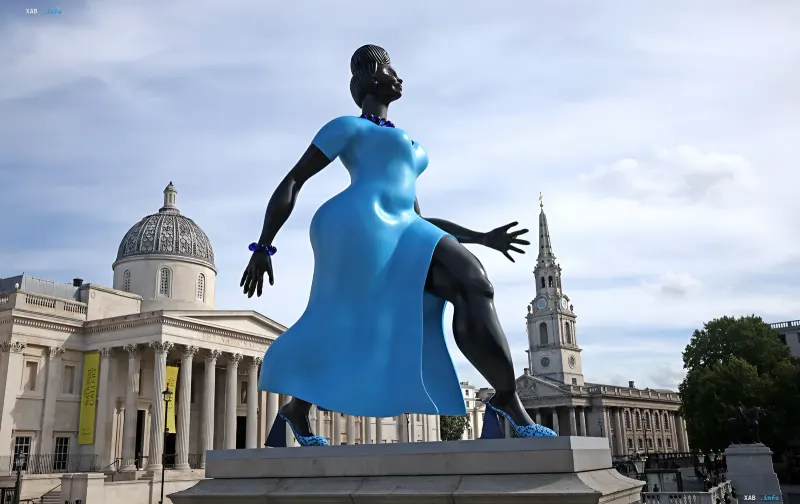
A new public sculpture — “Lady in Blue” by American artist Chabala Self — has been installed on Trafalgar Square in London. The bronze work has taken up the famous Fourth Plinth, where, by the organisers’ plan, it will be displayed for the next two years. The sculpture depicts an anonymous young Black woman in a form-fitting dress of a rich lapis-lazuli hue, wearing high heels and jewellery made of glass beads. Her hair is braided, and the figure is captured in the moment of a confident step forward — it is precisely this movement that forms the central visual and conceptual core of the composition.
A symbol of movement, not a static monument
Chabala Self emphasises that her work deliberately departs from the tradition of monumental sculpture turned towards the past. “She is not static. She has a desire to move,” the artist explains. In her words, the aim was to create a figure embodying courage, optimism and movement towards the future, rather than the memorialisation of a specific historical person. Self hopes that the image of a woman confidently stepping forward will become, for viewers, a metaphor for the possibility of moving on in their own lives.
The lapis-lazuli colour and the details of the image
The sculpture is distinguished by its thoughtful detailing. The heroine’s dress is executed in a lapis-lazuli shade — a colour inspired by the rare mineral that has been used for centuries as a pigment in painting and decorative arts. The image is complemented by braided hair, glass beads on the neck and wrists, and high-heeled shoes with a distinctive pattern. All the elements form the portrait of a contemporary woman endowed with a striking character, yet not tied to any specific historical biography.
The context of the Fourth Plinth and public art
“Lady in Blue” has become the 16th work installed on the Fourth Plinth as part of the public art programme founded by the Royal Society of Arts. The project is now supported by the Mayor of London, Arts Council England and the Bloomsbury charity. The choice of an anonymous, non-historical figure against the backdrop of the classical monuments of Trafalgar Square — Nelson, Rodin, the previous plinth sculptures — makes the work particularly striking: it addresses the future, whereas the surrounding architecture and monuments largely fix the past.
The representation of Black women in public art
The installation of the sculpture draws attention to the question of the representation of Black women in British public art. At the same time, Self notes that she would not want her work to be perceived exclusively through the prism of racial or gender identity. For the artist, the sculpture is above all an image of a person who has the right simply to exist as they are — without any obligatory tie to a social or political category.