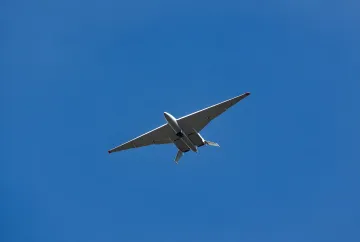
A revolution is brewing in the world of unmanned technology that could radically change the approach to long-duration missions. Chinese researchers have presented an innovative solution that allows drones to be charged mid-air using a laser beam directed from the ground. Details of the development, published in ScienceDirect, demonstrate how engineers managed to overcome the main obstacle of wireless power transmission — critical overheating of equipment.
The heat problem and the solution
For a long time, high-power energy transmission remained the "Achilles' heel" for autonomous aircraft. Powerful lasers required for charging instantly heated compact receivers, leading to a drop in efficiency and even melting sensitive components. To overcome this barrier, scientists developed a unique two-layer tandem device design.
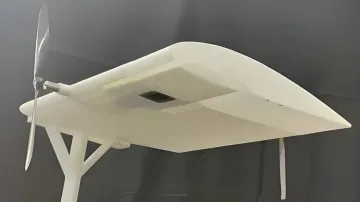
Thermal barrier nanocrystals became the key protective element. During tests, thermal imagers recorded equipment heating up to extreme 80–90°C, but the new system allowed the device to remain operational. Instead of overloading the fuselage with bulky cooling systems, engineers placed an ultra-thin receiver under the drone's wing.
Principle of operation: from headwind to electricity
The brilliance of the solution lies in the use of aerodynamics. A special system of air channels allows the oncoming airflow to pass through the wing, naturally cooling the back of the receiver. This creates the necessary temperature gradient: the front side heats up from the laser, while the rear remains cool.
It is precisely this temperature difference that causes the thermoelectric layer to generate additional energy. The prototype, installed on a stationary drone model, successfully converted green laser energy into electricity, while the airflow from the propellers provided the necessary heat dissipation.
Record efficiency and prospects
The results of laboratory tests are impressive: the efficiency of converting light into electricity reached 38.49 percent. This is a figure that opens the door to creating drones with practically unlimited flight time. In the event of successful commercialization, the technology will allow drones to perform round-the-clock missions for forest monitoring, disaster relief, and cargo delivery without the need to land to change batteries.
Barriers to mass adoption
Despite successes with prototypes, there is still a complex stage of refinement before the technology hits the market. Engineers face a number of non-trivial tasks:
- Teach optical systems to accurately track a moving drone at a distance of several kilometers in real weather conditions.
- Ensure absolute flight safety, eliminating the risk that a high-power green laser could accidentally blind pilots of civil aviation.
Solving these problems will be the final touch, turning a laboratory experiment into a real technology capable of changing logistics and monitoring in the future.