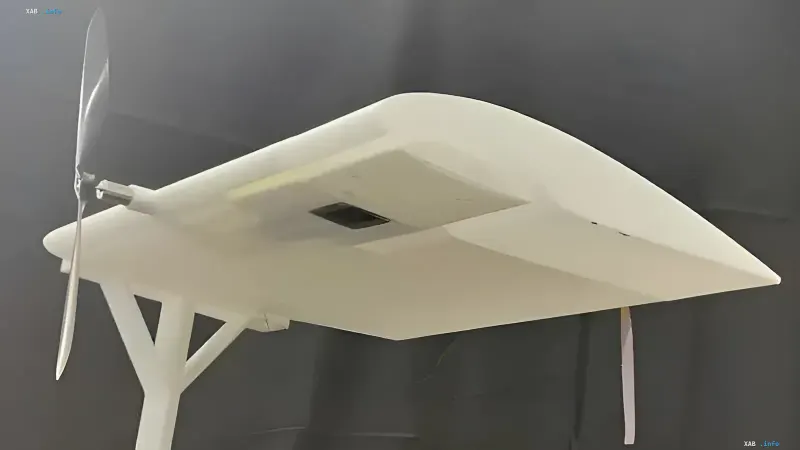
Amid the rapid development of unmanned technologies and tightening sanctions on the import of Chinese electronics (specifically following the US ban on DJI drones at the end of 2025), Beijing is betting on radical technological superiority. A group of scientists from the Civil Aviation University of China (CAUC) has presented a revolutionary solution to the problem of drone autonomy — a wing-mounted energy receiver capable of charging the device from a ground-based laser directly during flight.
Tandem Architecture: Perovskite and Thermoelectricity
The development, published in the prestigious journal Matter & Light under the leadership of Han Jianhua, radically changes the approach to powering aircraft. The technology is based on a unique tandem architecture. The upper layer of the receiver is a specialized perovskite cell tuned to capture green laser light with a wavelength of about 520 nanometers. However, the innovation is not limited to just the photovoltaic effect.
Under the perovskite layer is a thermoelectric generator. Its task is to utilize waste heat, inevitably generated during the operation of the optical element, and convert it into additional electricity. It is precisely this dual structure that allowed engineers to achieve record efficiency values (efficiency) that are unavailable to traditional single photovoltaic cells.
Solving the Overheating Problem and Nanocrystals
The main obstacle to the implementation of such systems has always been critical overheating. Concentrating powerful laser radiation on a compact receiver could raise the temperature to 80–90 °C, threatening rapid degradation of the perovskite and damage to the drone structure. To solve this problem, the team introduced antimony triselenide nanocrystals into the receiver matrix.
These nanocrystals have low thermal conductivity and create a protective barrier for the sensitive layer. This allowed maintaining the necessary temperature difference for the effective operation of the thermoelectric generator, as well as increasing the size of perovskite crystallites, reducing internal defects, and improving electron transport.
Aerodynamics and Test Results
Engineers also integrated air cooling channels directly into the wing structure. The airflow during flight actively cools the back side of the thermoelectric layer. Such a design performs three functions: increases electricity generation, reduces aerodynamic drag, and creates additional lift.
During laboratory tests, the fully assembled receiver ensured continuous rotation of the drone engine at a speed of 7820 revolutions per minute. The system operated stably, without power drops or signs of overheating characteristic of unoptimized analogues.
Contradictory Data and Practical Barriers
Despite the success of the prototype, experts note serious discrepancies between laboratory conditions and reality. As noted by HotHardware, the implementation of the technology will face difficulties in automatic tracking of a moving target in conditions of turbulence and cloudiness. Moreover, the use of high-energy beams will require the development of strict safety protocols to exclude risks to wildlife and manned aviation.
At the same time, considering the context of 2026, when the defense forces of many countries already use predominantly Chinese drones (according to sources from the Baltics), the emergence of infinite flight technology could become a factor shifting the balance of power towards Beijing, despite political restrictions.