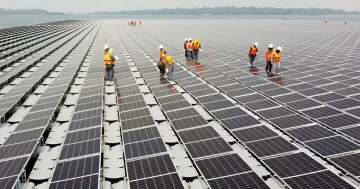
In August 2026, the renewable energy world witnessed a historic moment. A joint team of Chinese and Canadian researchers conducted a large-scale field test, deploying the world's first full-scale solar power plant based on perovskite cells. This event marks the transition of the technology from laboratory conditions to real-world industrial operation, demonstrating the potential of perovskites as a serious alternative to dominant silicon.
Technological Breakthrough: From Inkjet Printing to Efficiency Records
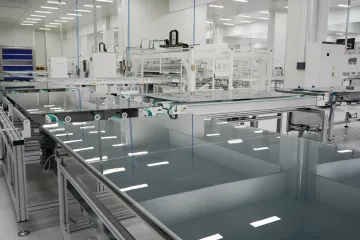
The key advantage of perovskite panels is their manufacturing method. Unlike heavy and energy-intensive silicon wafers, perovskite cells are created using inkjet printing on thin, flexible films. This not only reduces the cost but also decreases the weight of the structure, opening up new possibilities for installation. During tests conducted by scientists from Nanjing University in collaboration with Renshine Solar, a record efficiency was confirmed.
On a single module with an area of 810 cm², researchers achieved a certified efficiency of 24.0%. When scaled up to the level of a station consisting of 150 modules, each with an area of 0.72 m², the average output was 144 W, while the best module demonstrated an efficiency of 22.0% and a power output of 158.4 W. This set a new record for perovskite modules of this size.
Field Tests: Perovskite vs. Silicon
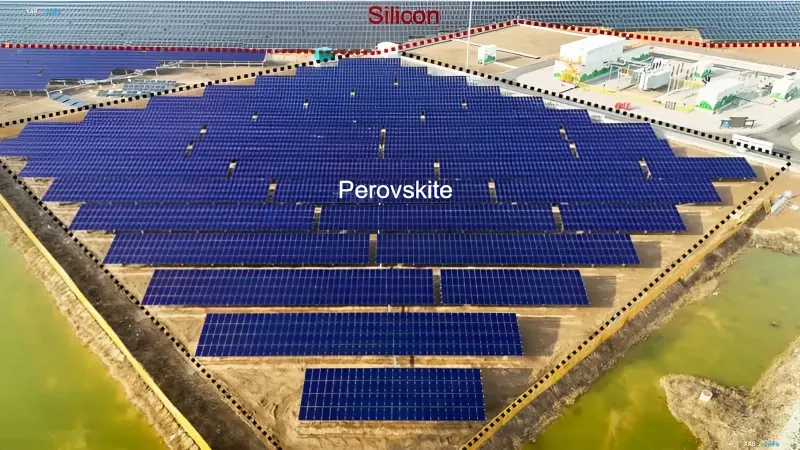
To objectively evaluate the technology, a 1 MW solar plant based on perovskite panels was deployed next to a 3.5 MW silicon installation. A comparison of specific output over three months (March, April, May) showed a consistent superiority of the new technology. Normalized to the same installed capacity, the perovskite system generated 3.42% more energy in March, 3.79% in April, and 5.81% in May.
It is important to note that the advantage of perovskites grew as air temperature and solar radiation intensity increased. This indicates that the new technology is particularly effective in hot climatic conditions, where silicon panels often lose performance due to thermal overheating.
Durability Issue Solved: Two-Component Coating
The main obstacle to the commercialization of perovskites for a long time was their instability to moisture and degradation under environmental impact. During this project, a new coating formulation developed to protect photovoltaic cells was successfully tested. The technology is based on a two-component composition: first, iodine salts are applied to the surface to ensure strong adhesion, followed by lead compounds.
The durability test results were impressive. After 1,300 hours of exposure to extreme conditions (85 °C temperature and 85% humidity), modules with the new coating lost only about 2% of their initial efficiency. For comparison, samples with standard coating lost 39% efficiency over the same period. The modules successfully passed a comprehensive test suite according to the IEC 61215 standard, significantly bringing the technology closer to mass industrial implementation.