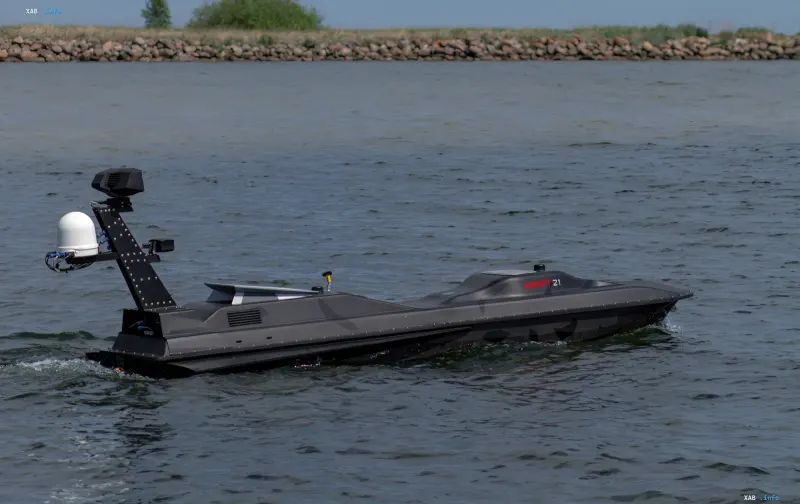
The Latvian company NEWT21, specializing in the development of unmanned maritime systems, has officially completed a key stage in the development of its flagship products. As reported by RBC-Ukraine citing a statement from the manufacturer on LinkedIn, the FOG and RAY models of maritime drones have moved from the stage of experimental prototypes to the level of full-scale serial production. This event marks an important step in the development of autonomous maritime technology, which has already proven its effectiveness in real combat conditions and in international exercises.
EU support and finalization of technologies
The transition to mass production became possible thanks to the implementation of the project "Modernization of the Unmanned Surface Vehicle (USV) and preparation of the production process." The initiative received significant financial support from the European Union through the European Regional Development Fund. Within the framework of this grant, NEWT21 engineers conducted deep integration of onboard systems, a series of stress tests, and prepared final technical documentation. It was precisely the availability of standardized documentation that allowed the company to launch conveyor production and begin commercial implementation of the units, ensuring their stability and reliability for customers.
Tactical FOG: reconnaissance and interception
The FOG model is positioned as a high-speed tactical drone created for rapid deployment in coastal zones. The unit's hull is made of composite materials — carbon and aramid fiber, which ensures high survivability and speed. The main purpose of FOG is covert reconnaissance and target interception. Practical application of this unit is already taking place: the Armed Forces of Ukraine are actively using FOG for patrolling and reconnaissance missions in the Black Sea. Furthermore, the system's potential was demonstrated on an international level: the Spanish company UAV Navigation-Grupo Oesía showed an autonomous control system based on FOG during US special forces exercises in Cartagena, confirming the compatibility of Latvian equipment with Western standards.
Multi-purpose RAY: logistics and amphibious support
The company's second flagship — RAY — is a larger and more load-bearing unit. This is a multi-module platform designed to solve a wide range of tasks: from logistics and hydrography to surveillance. NEWT21 offers RAY as a universal solution for cargo delivery and medical evacuation; the design provides fixed mounts for four stretchers. In addition, the drone is capable of supporting the landing of ground robotic systems and serving as a carrier for interceptor drones or mine countermeasure equipment. Fleet management is carried out from a single ground station capable of simultaneously controlling up to 32 units, allowing for the coordination of complex group operations.
Context: the fight for the security of maritime corridors
The serial production of these drones is taking place against the backdrop of heightened interest in maritime interception systems. It was previously reported that the Danish company BlueShadow is considering the possibility of countering ballistic missiles and hypersonic weapons using the Blue Dragon system. The protection of corridors for civilian shipping in the Black Sea has become a key part of the mission of such developments. The appearance of serial Latvian drones FOG and RAY complements this ecosystem approach, offering flexible tools for reconnaissance, mining, and area protection, which is critically important for ensuring regional security in current geopolitical conditions.