August 17, 2026: A debate has flared up again in Ukraine's information space regarding forecasts for the upcoming heating season. The trigger for the discussion was statements by Denis Yaroslavsky, an officer of the Assault Forces Command of the Armed Forces of Ukraine (AFU), who predicted unprecedented restrictions in major cities. However, information security experts have already labeled these words as fear-mongering and urged citizens to remain calm.
Assault Force Forecast: "Lockdowns unseen even this winter"
Denis Yaroslavsky, an officer of the Assault Forces Command, outlined a pessimistic scenario for the winter of 2026–2027 in his commentary. According to him, Russia will not stop, and no ceasefire is expected. Consequently, he suggested that "lockdowns" lasting up to two weeks are possible in Kyiv, Odesa, and Kharkiv.
"This winter we will have lockdowns for 2 weeks. In Kyiv, Odesa, and Kharkiv, there will be lockdowns that we haven't seen even this winter," the officer stated. His words, published on social media, quickly gained popularity and sparked a wave of anxiety among residents of major cities who are already worried about energy supply stability.
CDD Reaction: "Another instance of fear-mongering"
Andriy Kovalenko, head of the Center for Countering Disinformation (CDD), promptly responded to his colleague's statement. In a comment for RBC-Ukraine, he emphasized that information about "two-week lockdowns" is merely a personal opinion and lacks a factual basis.
Kovalenko pointed out a terminological inaccuracy: "Another scaremongering about 'lockdowns' in Kyiv, Kharkiv, and Odesa is something new. First, I advise the commentator to study what a lockdown is when talking about 'even stricter than this winter.' We did not have lockdowns last winter. The last ones were during the COVID pandemic."
The CDD expert urged citizens not to succumb to panic and reminded them that the blackout forecast is just the assumption of an individual who has no connection to the strategic issues of preparing the country for winter.
Context: Real threat and strikes on energy infrastructure
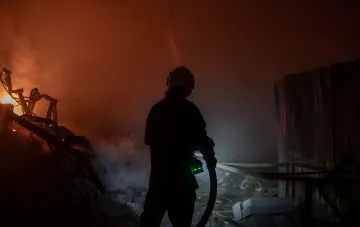
Despite the debunking of rumors about total lockdowns, the threat to energy infrastructure remains real. Today, August 17, 2026, Russia struck an energy facility in Chernihiv. As a result of the attack, more than 10,000 subscribers in the city were left without power.
Furthermore, the Main Directorate of Intelligence (GUR) of the Ministry of Defense of Ukraine reports that Russian special services are preparing massive shelling of energy infrastructure. According to intelligence, starting in autumn, shelling of energy facilities, including gas ones, may intensify significantly. Andriy Kovalenko added in his commentary: "Less panic. We have gone through many winters, but this one could be truly special for the enemy if they do not stop the strikes."
Contradictory data
In the situation with winter forecasts, there is a clear gap between military assessments and those of information security specialists. On one hand, Denis Yaroslavsky, relying on his experience and the current tactical situation, predicts a critical scenario with prolonged blackouts. On the other hand, Andriy Kovalenko, representing the CDD, categorically denies the possibility of introducing "lockdowns," calling it terminologically incorrect and a panic-inducing statement.
The difference in versions lies in the interpretation of the term "lockdown" and the degree of expected restrictions. If for a military officer this may mean a complete halt of life activities due to the lack of light and heat, for the CDD this is a concept that does not apply to the current situation in Ukraine, as the country has already adapted to living conditions during wartime.
Psychological warfare and societal adaptation
Disputes over winter forecasts have become part of a broader information campaign. The Russian side actively uses the topic of the energy crisis to demoralize Ukrainian society. In response, Ukrainian authorities and experts try to curb panic, emphasizing the adaptability of the system and the resilience of the population.
As Andriy Kovalenko noted, it is important to distinguish between real threats and information noise. Although strikes on energy facilities will continue, the introduction of total lockdowns comparable to the pandemic is unlikely. Ukraine has already gone through several difficult winters and has developed survival mechanisms that allow minimizing damage from enemy attacks.