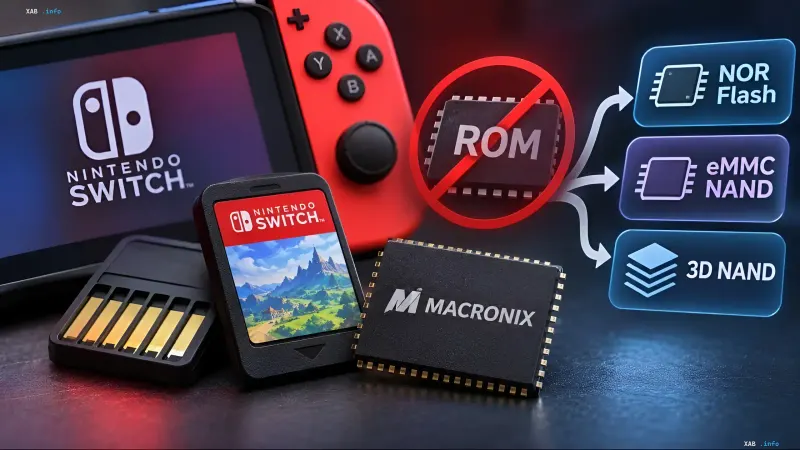
Taiwanese company Macronix has announced the cessation of new product development based on ROM memory. The manufacturer intends to focus its resources on NOR Flash, eMMC NAND, and advanced 3D NAND technologies, gradually reducing production capacity for traditional microchips. For the gaming industry, this decision is notable because Macronix has supplied memory for Nintendo DS, 3DS, and the original Switch cartridges for many years, remaining one of the key component manufacturers for physical game editions.
From ROM to Flash Memory: A Strategic Pivot
The redistribution of resources within the company is driven by economics. For the third quarter, Macronix's revenue reached NT$24.237 billion, a 195% increase year-over-year. At the same time, ROM chip manufacturing revenue dropped by 39% over the same period, while NOR Flash sales surged by 158%, and NAND sales by 768%. Chairperson and CEO Miin Wu stated that demand for NOR Flash memory for data centers is extremely high, and clients are demanding increased production capacity. The company also expects further increases in memory chip prices and plans to invest over NT$30 billion in production development, including new capacities to be rolled out through 2028.
Long-Time Nintendo Partner Shifts the Balance of Power
The industry's transition to the Nintendo Switch 2 has already altered the vendor landscape. Rohm (Oki Semiconductor) has secured a leading role in producing cartridges for the new console, while Macronix's involvement in memory supply for the Switch 2 has not yet been confirmed. Thus, one of Nintendo's long-standing partners is gradually stepping away from the technology used in gaming cartridges for decades, although a complete halt to existing chip production is not yet on the table.
Impact on the Gaming Industry and Prices
The abandonment of further ROM development does not mean an immediate halt to the production of active chips, but in the long term, the decision could affect the availability and cost of traditional game cartridges. Analyst David Gibson notes that the departure of a major partner will increase pressure on already strained supply chains, which could make physical games more expensive. Against this backdrop, publishers are increasingly considering the Game-Key Cards format for the Switch 2 — cartridges containing a download key rather than a full copy of the data — as an alternative to more expensive media. Previously, Sony announced its intention to move away from physical media for PlayStation, while Nintendo, in turn, confirmed about a month ago that it has no plans to abandon physical games.
Production Phase-Out Timeline
According to industry sources, Macronix's ROM chip production is planned to be completely phased out by the end of the third quarter of fiscal 2026. This means that in the coming months and years, the market will observe how the reallocation of capacity toward server flash memory impacts supply chains for handheld console components. However, the cessation of physical Switch game production is not on the agenda at this stage.