One of the most acclaimed games on the original Nintendo Switch — The Legend of Zelda: Tears of the Kingdom — has been shown running on a personal computer equipped with a graphics card featuring just 2GB of VRAM. The game has no official PC port, but the enthusiast community is increasingly leveraging artificial intelligence tools to create their own console title transfers. In this exact vein, a Reddit user under the pseudonym Accomplished_Law_237 demonstrated their own port, which functions stably on a setup combining an Nvidia MX550 mobile graphics card and an Intel Core i7-1255U processor.
What the enthusiast specifically demonstrated
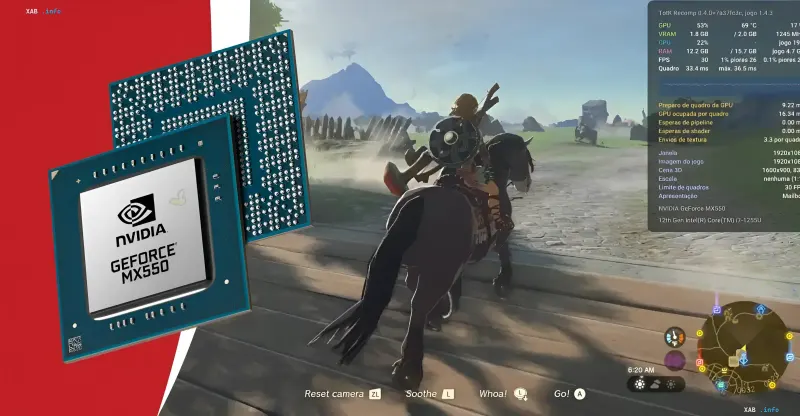
The published screenshot shows gameplay: a character riding a horse in an open-world location with mountains and stone ruins in the background, with performance monitoring overlaid on top of the frame. According to the overlay, the game maintains a target 30 frames per second at around 53% GPU load and 69 °C temperature, while video memory consumes 1.8GB out of the available 2.0GB, CPU load stands at 22%, and RAM usage is 12.2GB out of 15.7GB. Average frame time (Quadro) stays at 33.4 ms with a peak of 36.5 ms, window resolution is 1920×1080 with 3D scene rendering at 1600×900. To an inexperienced observer, this picture looks almost impossible for a AAA project, but for mobile GPUs, it is entirely expected.
What Nvidia MX550 is and why this is modest hardware
The Nvidia MX550 is a discrete mobile graphics card introduced in 2021. Its specifications by desktop standards look modest: only 2GB of video memory, a 64-bit bus, and 1024 CUDA cores based on the Turing architecture. Such cards were installed in budget and mid-range laptops, targeting office tasks, streaming, and lightweight games. The fact that a full-fledged open-world Zelda runs on it with an acceptable framerate highlights how optimized the original game engine is and how efficiently the enthusiast port works.
Why the result is not as surprising as it seems
Experts note that there is little reason for special astonishment here: the Nintendo Switch console itself is built on the Tegra X1 system-on-chip, whose Maxwell-generation GPU contains only 256 CUDA cores. Thus, even the mobile desktop form-factor MX550 card with its 1024 CUDA cores is objectively more powerful than the graphics block of the original console on which the game was created. This explains why the port is able to run stably: the target platform in terms of computing power does not lag behind, and in some aspects surpasses, the original hardware.
Context: the AI port trend and significance for weak hardware
The demonstration fits into a broader trend: enthusiasts are increasingly applying artificial intelligence models to automate and accelerate the creation of unofficial PC ports of console games. For budget laptop owners, this means that even long-outdated graphics cards by desktop standards are capable of running major titles, albeit at moderate settings and framerates. At the same time, it is important to emphasize that this is strictly a non-commercial enthusiast project without any official approval or support from Nintendo, and the very fact of the port's operation is confirmed by published screenshots and performance monitoring data.