On November 21, Ukraine marks the Day of Dignity and Freedom — the anniversary of the beginning of the Orange Revolution and the Revolution of Dignity, events that changed not only the country's political course, but Ukrainian society itself. Ahead of this date, RBC-Ukraine interviewed Ihor Poshivailo, acting general director of the National Memorial Complex of the Heroes of the Heavenly Hundred — Museum of the Revolution of Dignity, about how the perception of Maidan has changed over the years and why, more than a decade after the executions, the museum has still not been built.
Updated memorial space to open on November 21
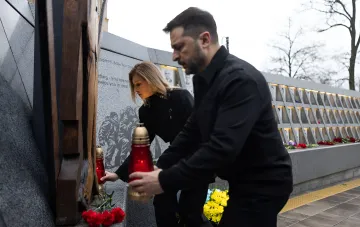
According to Poshivailo, in May Volodymyr Zelenskyy supported a bill that unblocked the construction of the Maidan Museum. Since then, as the head of the complex reported, it has been possible to update the memorial space on the Heavenly Hundred Alley near the Ecumenical Church of the Archangel Michael and the New Martyrs of Ukraine of the UGCC — a site that emerged immediately after the executions on February 20, 2014, and where concerned Kyiv residents brought flowers to honor the Heavenly Hundred. The chapel and the oak cross, which had fallen into critical condition over the years, were restored, and a granite memorial stele with portraits of the heroes and QR codes providing more information about their biographies was installed. It is this updated space that will open on November 21.
Why the Maidan Museum is still not built
The white granite memorial stele — an element of the project that won the International Architectural Competition for the Memorial in 2018 — is planned to be exhibited until May 2027. According to the design, it should stand on the Heavenly Hundred Heroes Alley near the floral clock, but this territory is still under arrest at the request of the Prosecutor General's Office due to unfinished investigative actions and the lack of court verdicts for those responsible for the Maidan executions. Since work can only be carried out on unarrested plots, the stele will be installed near the October Palace, where the museum is supposed to be built. Poshivailo clarified that the National Memorial Museum Complex consists of two parts: the Heroes of the Heavenly Hundred Memorial on the former Instytutska Street (from the intersection with Khreshchatyk to Olhynska Street) and the museum building near the October Palace, the territory of which is not under arrest. Design work began in 2021, but the full-scale invasion halted it due to lack of funding; the adopted law allowed the use of already purchased materials. At the same time, there are no funds in the state budget for construction: back in 2021, design work alone was estimated at approximately 50 million hryvnias, and the construction itself at about a billion. According to the design by German architects, it is to be a six-story building with a space of 27,000 square meters, modern infrastructure, and new technologies.
"We still live in Yanukovych's Ukraine"
Poshivailo noted that even before the full-scale invasion, manipulations regarding the construction were voiced in society: they said that if the museum and memorial were built, the territory would lose its authenticity and it would become impossible to bring the perpetrators to justice. In his assessment, this narrative was generated in Russia. Every year, investigators and the Prosecutor General's Office report on the work done, but there are still no court decisions. "Perhaps there are still pro-Russian forces that are not interested in the truth and are dragging out the process," believes the head of the complex. He emphasized that judicial reform is needed to make Ukrainian justice fast, effective, and fair, adding that in the context of justice, the country still lives in "Yanukovych's Ukraine," since one of the demands of Maidan — changing the judicial system — has never been fulfilled.
The complex's work in wartime conditions
With the start of the full-scale invasion, part of the memorial complex's staff went to the front as volunteers, and the rest of the team undertook the evacuation of collections due to the threat of their destruction. Poshivailo recalled that as early as the summer of 2021, foreign colleagues urged preparations for this, as the Maidan Museum is on the list of institutions to be liquidated in the event of the occupation of Kyiv. From the first days of the full-scale war, together with partners, the public initiative "Heritage Rescue Headquarters" was created, which joined the evacuation of collections and the provision of humanitarian aid to institutions across Ukraine. A series of expeditions has also been launched, during which damaged objects are documented and evidence of crimes is collected.