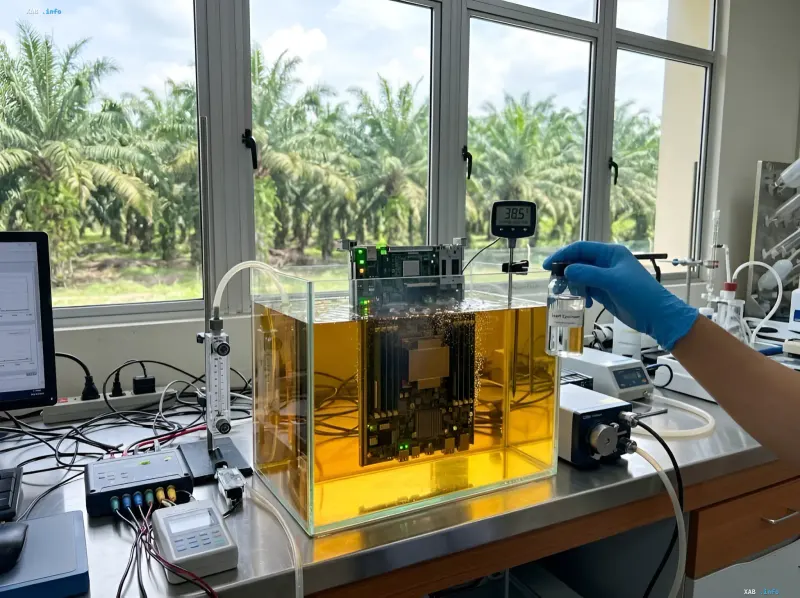
In a world where data center energy consumption is growing exponentially, Malaysia is offering an unexpected solution to the heat dissipation problem. The Malaysian Palm Oil Board (MPOB) has announced the completion of the final development stage of the innovative cooling liquid, Sawit EcoTherm. The new technology is based on palm oil, traditionally associated with the food industry and biofuels, but now it is vying to become a key component in artificial intelligence and cloud computing infrastructure.
Sawit EcoTherm Technology: From Plantation to Server
According to Dr. Nur Hairin Mohd, a senior scientist at MPOB, the new liquid was developed specifically for immersion cooling—a method where server equipment is fully submerged in a dielectric medium. Unlike traditional air-cooling systems, which require vast amounts of water for heat condensation, immersion systems operate in a closed loop. According to the developers, Sawit EcoTherm can significantly reduce the water footprint of the data center industry, which is critical given the global shortage of water resources.
Photos from the test sites show server racks submerged in a transparent yellow liquid, with the system temperature maintained at a stable level (around 38.5°C) while the equipment continues to operate normally. This confirms that the palm-based foundation possesses sufficient thermophysical properties to effectively dissipate heat from processors and memory chips.
Strategic Interest and the Cyberjaya Project
Malaysia, the world's second-largest producer of palm oil after Indonesia, sees this technology as a way to diversify its exports. Instead of selling raw materials solely for margarine or biodiesel production, the country is offering it to the high-tech sector. In support of this initiative, the state-owned construction corporation Selangor Industrial Corporation has announced a project to build a 65 MW immersion data center in the Cyberjaya tech hub. This facility will serve as a testbed for large-scale testing of Sawit EcoTherm in real-world conditions.
Competitive Landscape and Environmental Aspects
The liquid cooling market is not empty: it already features products based on fluorocarbons, synthetic mineral oils, and vegetable blends. For example, the American company Cargill already offers a liquid that is 90% vegetable oil. However, Sawit EcoTherm is distinguished by its positioning as a product created with national interests in mind and the availability of raw materials in Southeast Asia. MPOB hopes to collaborate with major data center operators to conduct independent tests and confirm the liquid's effectiveness in the long term.
Contradictory Data
Despite the developers' optimism, there are nuances that require attention. First, although a reduction in water consumption is claimed, the question of how effectively palm oil dissipates heat compared to synthetic dielectrics requires independent confirmation. Second, the environmental aspect of using palm oil remains controversial: critics of the industry point to issues of deforestation and biodiversity loss, which could create reputational risks for data centers using this technology. MPOB has not yet provided detailed data on how the sustainability of raw materials for Sawit EcoTherm is specifically addressed.