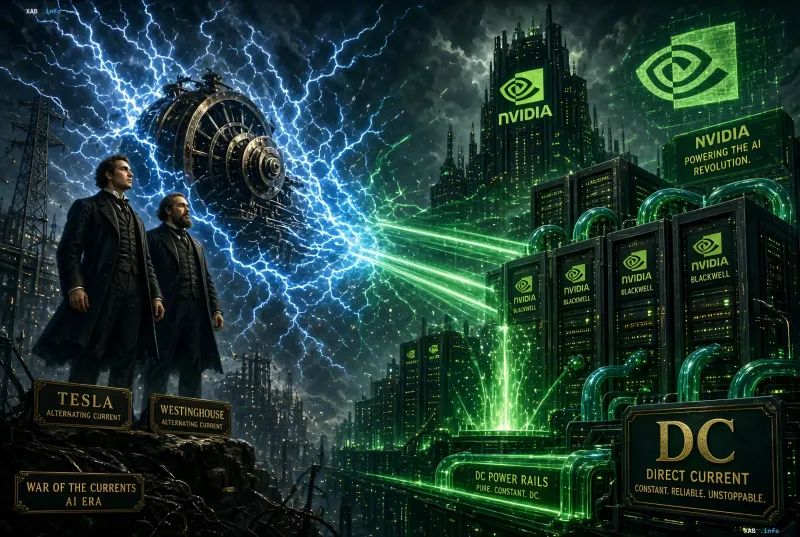
On August 17, 2026, the world of technological infrastructure is experiencing a historic turning point. Three industry giants—Nvidia, Google, and Microsoft—have announced a strategic alliance within the Open Compute Project (OCP) framework. Their goal is ambitious and fundamental: to accelerate the global transition of artificial intelligence data centers (DCs) to an 800V Direct Current (DC) power architecture. This event, which experts are already calling the "War of the Currents 2.0," challenges the dominance of Alternating Current (AC), which won over a century ago, in an era where computational density is growing exponentially.
Why has Alternating Current become a bottleneck for AI?
For decades, Alternating Current (AC) has been the de facto standard for electricity transmission, but in modern hyperscale data centers, it has become a serious limitation. Modern AI systems, especially those running on Blackwell architecture chips and subsequent generations, require colossal amounts of energy per rack. Traditional AC distribution schemes require multiple conversions (AC-DC at the input, DC-DC inside the server), leading to energy losses and excess heat generation. Furthermore, the high currents required to power dense servers at standard voltages necessitate the use of thick copper cables, complicating cooling and logistics within the data center.
The 800V Standard: Solving the Density Problem
The new standard promoted by the alliance is based on 800V Direct Current. The physics of the process are simple and effective: increasing the voltage allows the same power to be transmitted at a significantly lower current. This offers several critical advantages. First, it reduces the load on cables and conductors, allowing for thinner and lighter connections. Second, it reduces the number of power conversion points, increasing the overall efficiency of the system. Third, it paves the way for scaling AI system density without requiring each operator to develop unique, incompatible engineering solutions.
Open Compute Project Strategy: Unification Instead of Monopoly
It is important to note that Nvidia, Google, and Microsoft are not trying to create a closed proprietary standard. Their goal is to develop a common set of interfaces and system requirements that will become an open standard for the entire industry. This will allow data center operators to safely deploy equipment from different vendors, and suppliers to create compatible products without reinventing the wheel. In a press release published today, the companies emphasized that more than 80 partner companies are already developing infrastructure compatible with 800V DC, indicating market maturity and readiness for the transition.
Contradictory Data and Implementation Challenges
Despite the optimism of the giants, industry experts point out the complexities of the transition. The main point of tension is the inertia of existing infrastructure. Most power grids and transformer substations worldwide are designed for Alternating Current. The transition to 800V DC will require not just replacing servers, but a fundamental restructuring of power distribution systems within data centers. Additionally, there are disagreements regarding safety: high-voltage DC is harder to break in an emergency than AC, requiring the implementation of new types of circuit breakers and protection systems. There is currently no consensus on how quickly this transition can occur in regions with outdated energy infrastructure.