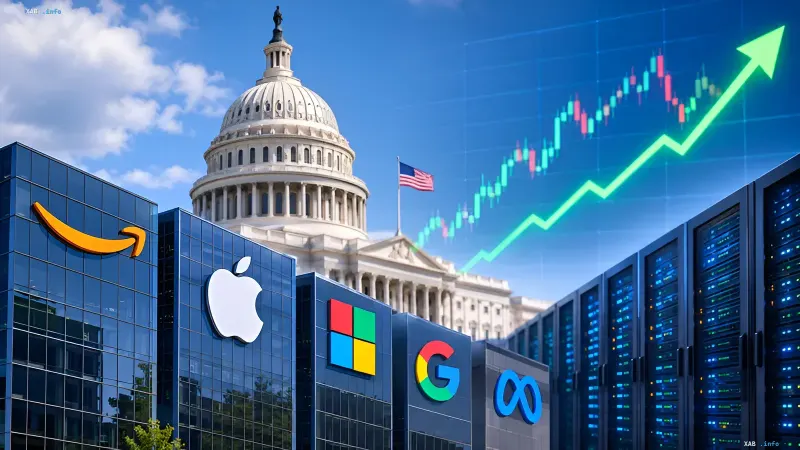
On November 4, 2026, the US stock market recorded one of the most prominent rallies among major tech companies in recent months. The catalyst was the results of the US midterm congressional elections, which, according to preliminary data, gave the Democratic Party control of both chambers. Investors quickly priced in the political shift: the transfer of legislative power to the Democrats, by their calculations, means a slowdown in runaway spending on artificial intelligence and a halt to the endless financing of new data center construction. By midday Eastern Time, Amazon shares rose 8.3%, Apple was up nearly 7%, and Microsoft, Alphabet, and Meta gained between 2% and 7%.
How Much the 'Brake' Costs: From $750 Billion to a Trillion Dollars
The scale of the market reaction was comparable to the largest capitalizations redistributions in Big Tech history. According to Reuters, if current dynamics hold, the combined market capitalization of the five largest tech companies could increase by more than $750 billion by market close. Bloomberg analysts offered a bolder forecast, expecting an increase of around $1 trillion. Simultaneously, capital redistribution occurred in the market: shares of AI infrastructure providers, including Applied Digital and IREN, fell by 6–13%. Investors fear that potential restrictions on data center construction will complicate the implementation of projects, many of which are debt-financed and thus vulnerable to a changing regulatory climate.
$740 Billion for Computing: Why the Market Decided Enough Is Enough
The reason for such a mixed market reaction lies in the unprecedented scale of infrastructure investments. According to analyst estimates, major tech companies plan to direct more than $740 billion in capital expenditures in 2026, compared to roughly $400 billion a year earlier. Amazon confirmed its capital expenditure guidance at around $220 billion for the year, while Meta estimates its spending in the $135–145 billion range. These sums, analysts emphasize, are largely covered by borrowings, putting corporations in a dependent position on credit markets and translating into lower net profits. At the same time, demand for computing power remains high: AWS reported a 39% increase in revenue in the third quarter of 2026, indicating a persisting deficit of capacity to service AI workloads.
Texas as a Key Hub: Hinojosa's Moratorium and Uncertainty
Texas is of particular importance to investors, potentially accounting for about 25–30% of future US data center capacity, according to analyst estimates. Democrat Gina Hinojosa, who won the state's gubernatorial election, advocates for imposing a moratorium on the construction of new data centers until additional regulatory rules are developed. This creates direct uncertainty for Microsoft, Google, and Meta projects already developing infrastructure in the region. At the same time, control of the Texas legislature remains with Republicans, and clarity regarding the newly elected governor's ability to actually halt already launched projects is currently lacking.
Expectations, Not Reality: What Actually Changed
It is important to emphasize that the actual stock price increase on November 4 reflects primarily changing investor expectations rather than a reduction in already announced investment programs. None of the top five companies has publicly withdrawn or revised its stated capital expenditure plans. The assumption that political pressure will lead to a slowdown in data center construction and reduced capital spending by tech giants remains a hypothesis for now. Democratic control of Congress does not automatically mean a nationwide ban on computing facility construction. Moreover, global competition does not stop: Chinese AI companies continue to build up their own computing power regardless of the US regulatory agenda. Thus, today's rally is a bet on a scenario that still needs to be confirmed by concrete legislative initiatives in the coming months.