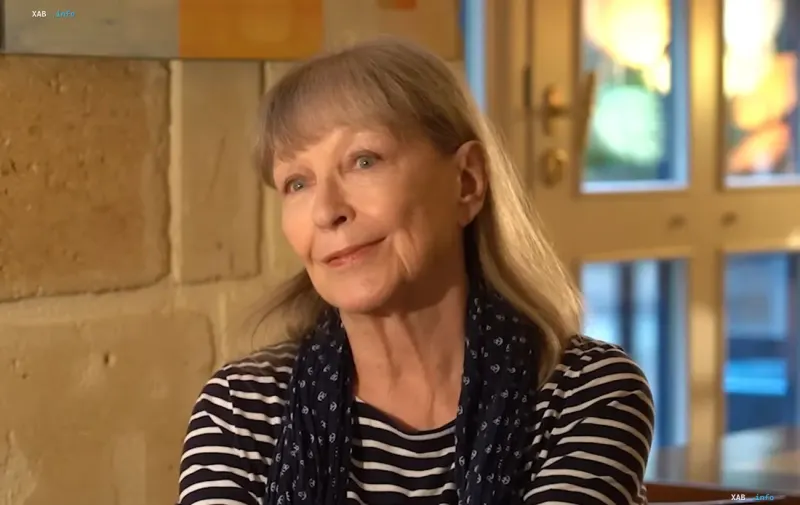
French actress, singer, and writer Marina Vlady died on September 24 at the age of 88. The news of the artist's death was announced by her relatives, who emphasized that she passed away "at home, surrounded by her loved ones and her pets," while the family did not disclose the exact cause of death. In the same statement, her close ones described her life as "long, beautiful, and well-lived." For cinema and culture, the loss of Marina Vlady is the loss of a figure who, for more than half a century, linked French and Russian art, and whose name remains inextricably tied to that of Vladimir Vysotsky.
From the Daughter of Emigrants to a Star of Cannes
The actress's real name was Ekaterina Marina Vladimirovna Polyakova-Baydarova. She was born on May 10, 1938, in France into a family of Russian emigrants: her father, Vladimir Polyakova-Baydarov, was an opera singer, and her mother, Militsa Envald, was a ballerina. Her film debut came in childhood — in 1949 in the film "Summer Thunderstorm," and in the 1950s she actively worked in French and Italian cinema: "The Devil's Daughter," "Crime and Punishment," "The Damned Go to Hell," "Poison," "The Witch." The turning point came in 1960 — the leading role in Jean Delannoy's "The Clever Princess" earned her the French Femina award as the best actress of the year, and international recognition was cemented in 1963 after Marco Ferreri's film "The Marriage Bed," for which Vlady received the award for best actress at the Cannes Film Festival.
Collaborations with Legends and Public Stance
The actress worked with directors such as Orson Welles, Jean-Luc Godard, Miklós Jancsó, and Bertrand Tavernier, appearing in films like "Falstaff," "Two or Three Things I Know About Her," and "Winter Wind." She has more than 80 films to her credit, as well as work in theater, television, and literature; she continued filming until the 1990s. Beyond the stage, Vlady was involved in public activism: in 1971 she signed the "Manifesto of the 343" — a petition by French women in support of the right to abortion. Russian literature, in particular Chekhov, held a special place in her work: she portrayed his heroines in theater and film and played the leading role in the film "Love for Chekhov."
Marriage to Vysotsky: Love at a Distance
A special place in the artist's life was occupied by the Soviet actor, singer, and poet Vladimir Vysotsky. They met in Moscow in 1967 and married in 1970 — for Vlady it was her third marriage, for Vysotsky his second. Because of the distance, the couple spent a significant part of their time apart: according to Vlady herself, for the sake of her husband she spent several months a year in Moscow. The relationship was not easy — Vysotsky had problems with alcohol and drugs, and Vlady tried to help him overcome his addictions. The last phone conversation between the spouses took place on July 23, 1980: Vysotsky planned to come to his wife in France soon, but on July 25 he died in Moscow at the age of 42. Later, the artist dedicated to him the book "Vladimir, or The Interrupted Flight," published in France in 1987. Marina Vlady was left with three sons from her first two marriages — Igor and Petr from the actor and director Robert Hossein, and Vladimir from the pilot Jean-Claude Brialy.
Stance After 2022
Marina Vlady lived and worked in the USSR for many years and knew Soviet life well, however, her devotion to Russian culture did not mean support for the Soviet regime — at various times she critically assessed the system in which she had spent part of her life. After the start of Russia's full-scale invasion of Ukraine, in March 2022, in an interview with a French publication she expressed her anger over the attack on Ukraine and noted that "this horror should have been stopped earlier." At that time, the actress recalled the Soviet regime, calling it "police-like, dictatorial, and deadly," and, according to her, this system did not disappear but continued to exist in modern Russia.