Maritime unmanned complexes (MUKs) have ceased to be a niche weapon in recent years and have become one of the key tools of naval warfare. In practice, Ukraine has demonstrated that relatively inexpensive unmanned systems are capable of changing the situation in an entire operational zone and influencing the actions of a significantly larger and more expensive fleet. This transformation is particularly evident in the Black Sea operational zone, where the maritime and unmanned components are increasingly integrated, forming new approaches to combat operations. As Vyacheslav Klementyev, head of the All-Ukrainian Federation of Military UAV Pilots, notes in an exclusive column for RBC-Ukraine, the most interesting thing today is not individual successful applications, but the speed at which the role of maritime drones themselves is changing.
From a strike raider to a multi-functional platform
Not long ago, a maritime drone was perceived primarily as a strike weapon — a raider whose task was to hit a target. Today, MUKs are becoming multi-functional platforms: they conduct reconnaissance, ensure communications, transport cargo, support units, and act as carriers for other unmanned systems. The range of tasks is expanding from simple target destruction to reconnaissance, logistics, delivery, evacuation, signal relay, and payload transport. According to experts, this is the next stage of development for maritime unmanned complexes: one complex is capable of performing several functions simultaneously — being a scout, a relay station, a transport platform, and a carrier for FPV drones or ground robotic complexes.
Maritime drone as a carrier: Zalizny Port and Kinburn
A striking example of this new logic was the combat use of the Barracuda MUK by the marines of the 40th Separate Marine Brigade of the Ukrainian Navy in the area of the temporarily occupied Zalizny Port in the Kherson region. A group of maritime platforms in various configurations delivered FPV drones directly to the mission area; after reaching the launch point, the air component joined the operation, targeting enemy logistics, transport, positions, and personnel. Meanwhile, the maritime platforms themselves came under attack: the enemy managed to disable one complex, but the others continued to perform the task. An even more indicative episode occurred on the Kinburn Spit, where a maritime platform delivered a ground robotic complex to the occupied coastline, disembarked it, after which the GRC completed the combat mission. In fact, this is an example of a robotic amphibious landing: the maritime system becomes a transport and carrier for a ground robotic platform, delivering it to places where sending people is too risky. Cases of MUKs being used to evacuate Ukrainian servicemen are also being recorded.
Network ecosystem: the next stage of development
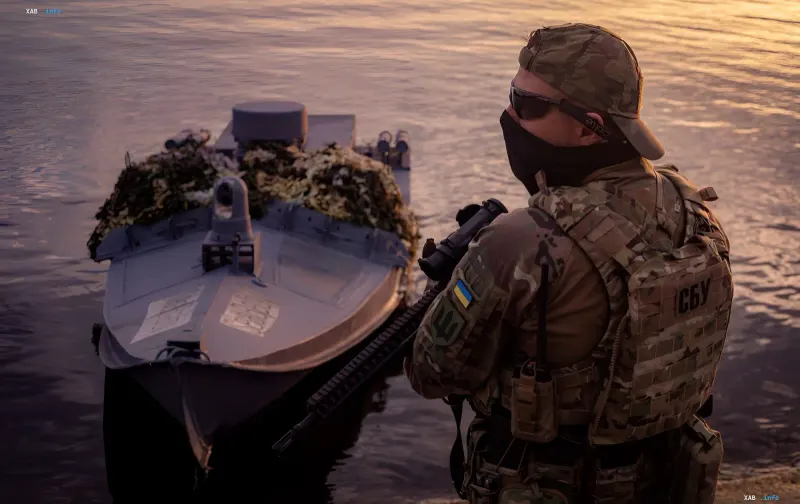
In the opinion of experts, the next step will be the joint operation of several maritime platforms united into a single control and interaction system. In fact, the industry is moving from individual drones to robotic systems in which the maritime, air, and ground components complement each other within the framework of a single combat task. It is important that technology is only part of the result: people, their training, experience, tactics, and the ability to work jointly with other crews and types of unmanned systems are no less important. That is why platforms for direct communication between operators, military personnel, developers, and manufacturers are being created — one of them is the Commander of the Navy Cup for Maritime Unmanned Complexes, organized with the participation of the All-Ukrainian Federation of Military UAV Pilots and the Weapons Council. Ukrainian maritime unmanned vehicles (archive photo).
Contradictory data
When interpreting public materials, there is a discrepancy in attribution: in a number of archive footage and open sources, maritime drones are associated with different agencies — SBU (Sea Baby / "Mamai" type platforms), GUR MO (Magura V5), and special units of the Navy. At the same time, in the expert analysis, specific combat episodes (Zalizny Port, Kinburn) are linked to the marines of the 40th Brigade of the Navy. Different agencies develop and apply maritime unmanned vehicles in parallel, so it is correct to use the neutral caption "Ukrainian maritime unmanned vehicles" in illustrations without linking to one branch of the armed forces. Moreover, the described episodes are presented as a military-analytical context and an illustration of tactical changes, and not as an urgent operational briefing from the headquarters, which should be taken into account when assessing the accuracy of details.
Conclusion: a new model of naval warfare
The totality of the described changes confirms the thesis of the formation of a new model of naval warfare, in which unmanned complexes are displacing traditional approaches and redistributing the balance of power in the water area. The transition from single strike drones to networked multi-functional robotic systems capable of carrying and launching other UAVs is no longer a forecast, but a recorded practice. Further development will be determined by both technological integration and the quality of operator training and the level of cooperation between agencies, developers, and manufacturers.