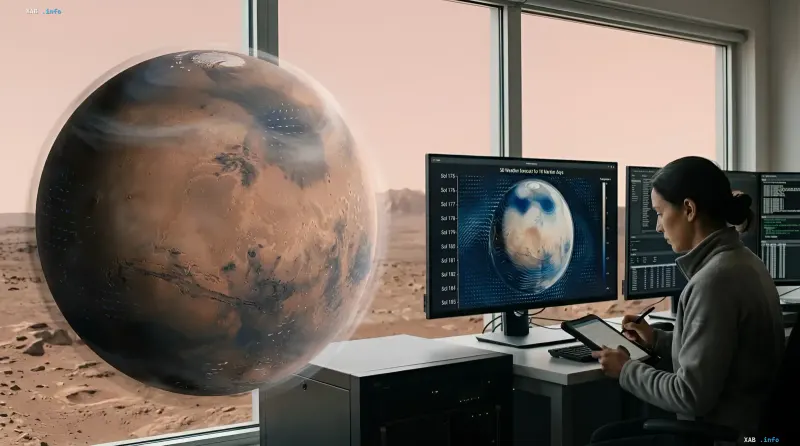
August 19, 2026, marked a landmark day for planetary meteorology. An international team of researchers successfully completed testing a new weather forecasting system for Mars, named "MarsCast." The development is based on the cutting-edge GraphCast neural network model, which previously demonstrated outstanding results in predicting Earth's atmospheric phenomena. Scientists managed to adapt algorithms trained on Earth's climate data to Martian conditions, where atmospheric physics differ radically due to the thinness of the air and a different chemical composition.
From Earth physics to Martian cyclones
Initial tests showed that the model, transferred "as is" from Earth, could only superficially imitate the current state of the Martian atmosphere. However, without deep refinement, the system quickly lost dynamics and could not correctly reproduce diurnal temperature fluctuations, which play a critical role on Mars. To solve this problem, researchers retrained the neural network using the extensive Mars Climate Database (MKD). This step allowed the algorithm to "understand" the specifics of the Martian environment, where thermal inertia and radiative balance work differently than on Earth.
Training efficiency and forecast accuracy
The training results exceeded the expectations of the scientific community. Already after 10 epochs (training cycles), MarsCast began to restore a reliable diurnal temperature cycle. After 300 epochs, using data from just 30 Martian days (sols), the model stabilized and began to demonstrate high accuracy. During final tests, the system successfully reproduced the seasonal and vertical structure of the atmosphere in 10-day forecasts and also accurately predicted wind movement patterns. This was a breakthrough, as traditional physical models require colossal computing power for such calculations.
Prospects for manned missions
The development of MarsCast is of strategic importance for the future exploration of the Red Planet. In the near future, researchers plan to expand the system's functionality by adding dust transport modeling and its impact on the radiation background. Dust storms on Mars can last for months and pose a serious threat to the solar panels of rovers and the safety of future colonists. The ability to assess risks in advance and plan missions using AI forecasts will become a key factor in the success of manned expeditions planned for the end of the decade.