
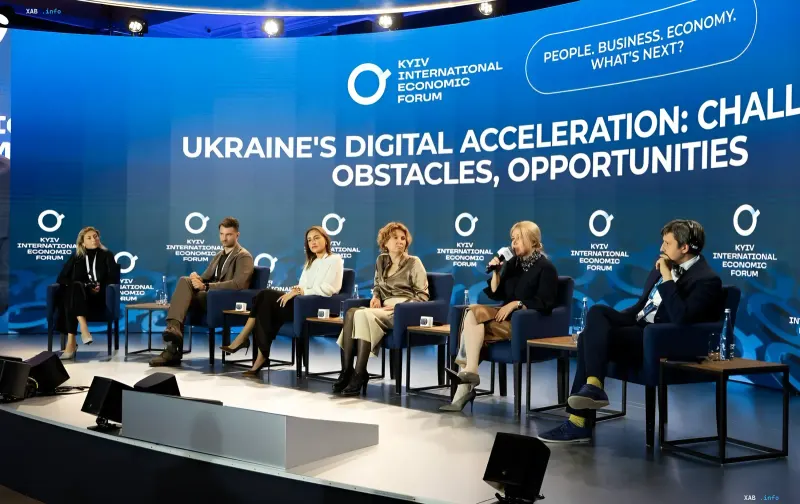
At the Kyiv International Economic Forum, Inga Andreeva, General Manager of Mastercard in Ukraine and Moldova, presented the company's strategic agenda in the field of artificial intelligence and cybersecurity. According to her, Mastercard has been using AI for two decades primarily to combat payment fraud, but the company is now actively developing a new direction — so-called agentic commerce, where AI agents make purchases on behalf of users. The first test transactions involving an AI agent have already been conducted in the Ukrainian market.
175 billion transactions and fraud patterns
Andreeva emphasized that the scale of Mastercard's global network allows the company to identify suspicious patterns and respond to them promptly in collaboration with partner banks. "In 2025, Mastercard processed 175 billion financial transactions worldwide. By analyzing such a volume of operations, we can determine characteristic patterns and understand which transactions are legitimate and which are suspicious — and we react instantly, either on our own or together with a partner bank," she explained. As a concrete example, the General Manager cited the Mastercard Safety Net solution, which helped prevent fraud amounting to over 50 billion dollars globally during 2022–2024.
13 billion dollars in cyber defense and the acquisition of Recorded Future
To strengthen cyber defense, in 2024 Mastercard acquired Recorded Future, one of the world's leaders in cyber threat intelligence. The company's technologies help to identify potential threats in advance, analyze risks, and prevent possible attacks. Since 2019, according to Andreeva, Mastercard has invested about 13 billion dollars in cybersecurity globally. In Ukraine, the company is working on strengthening the cyber resilience of the financial sector together with the National Bank: in March 2026, the parties signed a memorandum providing for the exchange of expertise and cyber threat analytics, as well as increasing the readiness of financial institutions for incidents.
Agentic commerce: AI buys on behalf of a person
Along with countering fraud, Mastercard is developing the direction of agentic commerce — a model where a user delegates to an AI agent the search for goods, the selection of offers, and the execution of purchases on their behalf. In June 2026, Mastercard, together with PrivatBank, conducted the first test transaction in Ukraine involving an AI agent. According to Andreeva, the test payment showed that agentic payments can work reliably and successfully in the Ukrainian market. To develop this area, the company launched a global solution called Agent Pay, which is based on tokenization (replacing the card number with a unique digital code) and Mastercard Payment Passkey, allowing for online payment confirmation via biometrics.
The "Know Your Agent" principle and regulatory issues
Specific requirements apply to the AI agent itself. According to the "Know Your Agent" principle, an agent must undergo identification and registration, and its actions must correspond to the user's confirmed intent and the limits set by them. The bank, merchant, and payment system must see that the payment is being carried out by an AI agent on behalf of a person. At the same time, according to Andreeva, clear rules are needed for the expansion of agentic commerce, which business and regulators must shape together: the user must understand what powers they grant to the agent, how to revoke permission, who bears responsibility in case of disputed transactions, and how their data is protected.
Demand for AI agents and satellite connectivity for POS terminals
There is already interest in such services in Ukraine: according to a Masterindex study, one in ten Ukrainians surveyed would like to use an AI agent for payments. As a reminder of another technological track of cooperation: in March 2026, as part of a strategic partnership, Kyivstar and Mastercard successfully tested Starlink Direct to Cell technology for POS terminals. It allows for 4G connectivity for POS terminals via a satellite network in places where traditional mobile coverage is absent or damaged, creating an additional communication channel for conducting payments and helping to maintain uninterrupted operation of the payment infrastructure.