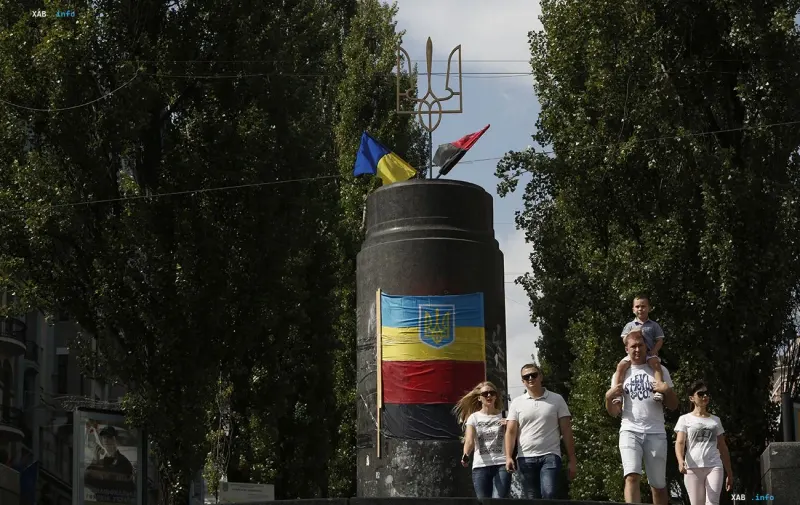
The Cabinet of Ministers of Ukraine has backed the Ministry of Culture's proposal to erect a monument to Ukraine's hetman Ivan Mazepa in Kyiv. According to a statement from the ministry shared with the media, the monument is planned to be placed on Taras Shevchenko Boulevard — at the site of the previously dismantled monument to Vladimir Lenin. Thus, the initiative, which President Volodymyr Zelensky publicly announced back in June 2026, has moved from the stage of political statements to the stage of practical implementation, with the customer, the organizers of the competition, and the sources of funding now defined.
The Cabinet of Ministers' Decision and the Role of the Ministry of Culture
As stated in the Ministry of Culture's message, the ministry itself will act as the customer for the design and production of the future monument. By backing the ministry's proposal, the Cabinet of Ministers has effectively set the institutional framework for the project: the installation site has been determined, the customer has been appointed, and the mechanism for selecting the design sketch has been outlined. This means that the monument's further fate will depend on the results of the competitive procedures and the approval of the design and cost documentation, rather than on one-off political gestures.
Open Competition and Sources of Funding
The appearance of the monument, as envisioned by the organizers, will be determined by the results of an open competition for the best design sketch project. Its conduct has been entrusted to three bodies: the Ministry of Culture, the State Agency of Ukraine for Arts and Art Education, and the Kyiv City State Administration. The installation of the monument and the improvement of the surrounding area, as noted in the materials, will be funded from the Kyiv city budget, while the design and production of the monument may be financed through other sources of funding not prohibited by law. The final cost of the project will only become known after the competition is completed and the design and cost documentation is approved.
Timeline: From the President's Initiative to the Decree
The initiative to erect a monument to Mazepa was announced by President Volodymyr Zelensky in June 2026. Its implementation was subsequently formalized by presidential decree No. 781 of August 21, 2026, "On the Issue of the Memory of Ukraine's Hetman Ivan Mazepa." Thus, by September 2026, the project already had a regulatory basis at the level of a presidential decree, and the Cabinet of Ministers' support became the next, more concrete step in the chain of decision-making.
Context: Barrier-Free Space and a Poll of City Residents
The decision on the monument fits into a broader process of transforming the space at the intersection of Taras Shevchenko Boulevard and Krechatchyk Street. In April 2026, the Kyiv City State Administration (Kyiv CCA) published a project for developing this area, whose main stated goal was the creation of a barrier-free environment. The initiative sparked a wave of criticism, after which a poll was conducted among the capital's residents. According to its results, about 80% of those polled supported the idea of developing a barrier-free public space with a fountain at the site of the former Lenin monument on Bessarabska Square, while in April the involvement of patrons' funds was discussed.
Contradictory Data
When comparing the different stages of the project's discussion, inconsistencies surface that are important to honestly record. First, the wording of the location changes: in April 2026, the Kyiv CCA and the poll of city residents operated with the concept of "Bessarabska Square" and the intersection of Shevchenko Boulevard with Krechatchyk Street, whereas in the message about the Mazepa monument the emphasis is placed on "Taras Shevchenko Boulevard" as the site of the monument's installation. Second, the sources of funding are also presented differently: in April, the discussion concerned patrons' funds for developing the space with a fountain, whereas in the decision on the monument, the installation and improvement are attributed to the Kyiv budget, while "other sources" are permitted for the design and production. Finally, the assessment of Mazepa's figure and the expediency of the monument is polarized in society: if for some this is the restoration of historical memory, then for others, as formulated in critical publications, the installation of a monument at the site of the Lenin statue is perceived as a controversial and provocative gesture. Both viewpoints exist simultaneously, and as of the time of publication, neither version regarding the details of the location and funding had been finally unified in a single document.
Political Resonance
The project is inevitably accompanied by public discussion that goes beyond urban planning. In the media space and the expert community, both supportive and sharply critical assessments are heard: some observers view the monument as a symbol of revising historical memory, while others see it as a politically motivated step capable of intensifying public disagreements. It is important for the publication to emphasize that, at the current moment, the confirmed facts are institutional in nature — the support of the Cabinet of Ministers, the appointment of the customer, the plan for an open competition, and the regulatory basis in the form of decree No. 781 — while the final appearance of the monument, the exact location, and the full cost remain open until the completion of the competitive and design procedures.