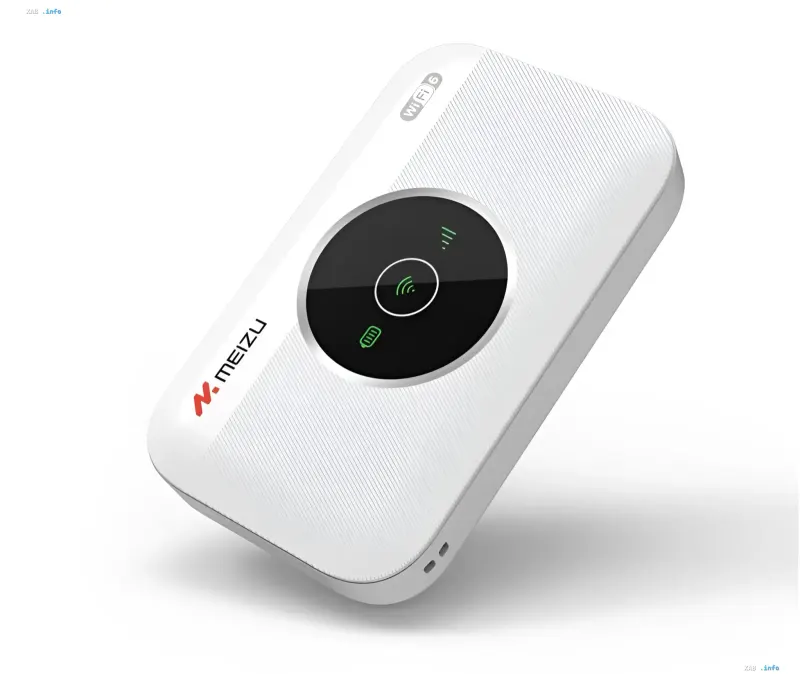
Meizu has listed a new accessory for mobile internet on its official website: the portable MIFI N1 router. The device comes in a white case with a distinct textured finish on the front panel and a round indicator display in the center that shows connection status, signal strength, and battery level. According to the source, the new device is priced at 79 yuan, roughly equivalent to $12 USD — a price point that makes it one of the most affordable in its class.
Connectivity: Wi-Fi 6 and 150 Mbps LTE
The key networking advantage of the MIFI N1 is its support for the Wi-Fi 6 standard, which provides a more stable connection and lower latency compared to previous generations. The router can support up to 16 connected devices simultaneously, making it suitable for small groups — such as teams on the go, families, or a single user with multiple gadgets. Peak download speeds over mobile networks (LTE) are stated at 150 Mbps, consistent with typical 4G segment figures and sufficient for comfortable streaming, video calls, and cloud service usage.
Battery, Dimensions, and Connectivity
The device houses a 3000 mAh battery, and a USB-C port is included for charging and, presumably, powering external devices. The manufacturer did not disclose specific battery life figures at the time of the announcement, so the actual runtime remains unknown. The device measures 96.6 × 58 × 14.8 mm and weighs approximately 102 grams, confirming its positioning as a compact "pocket" solution that is easy to carry in a bag or pocket.
Positioning and Target Audience
The combination of a low price, Wi-Fi 6 support, multi-user mode, and compact dimensions suggests that the MIFI N1 is aimed at mass-market users who need backup or mobile internet without being tethered to a home router: for trips, business travel, or areas without reliable Wi-Fi. For such scenarios, the stated features — sufficient LTE speed, high device capacity, and an integrated battery — are key. As there are no independent test results or verified battery data available at the time of publication, some specifications should be treated as manufacturer claims.