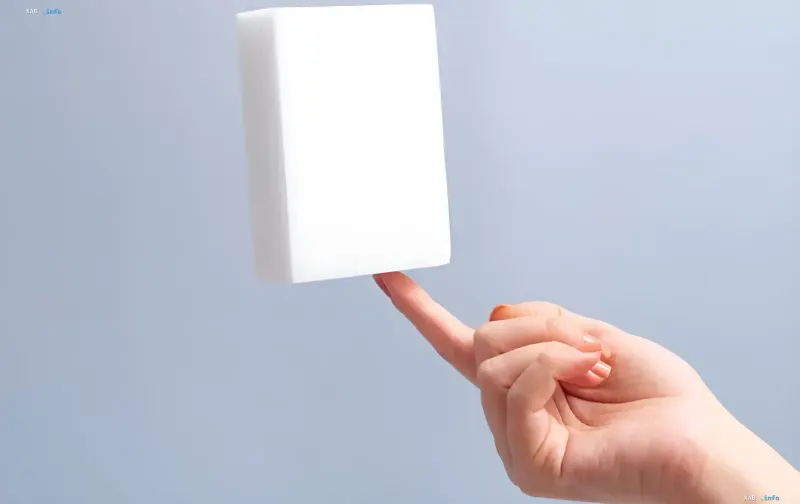
A melamine sponge is most often bought “for the kitchen,” but its real potential is considerably broader. According to the Styler project (RBC-Ukraine), it is a special sponge made of melamine foam that works as a very delicate abrasive: to remove a stain, you just need to dampen it with water and gently rub the surface, without using a large amount of detergent. It is precisely this principle — mechanical wiping by the foam's micro-particles rather than chemical dissolution — that defines both its strengths and its limitations.
How a melamine sponge works
Melamine foam consists of numerous fine fibers that, when rubbed against a surface, behave like ultra-fine sandpaper. Thanks to this, the sponge removes set-in stains, scuffs, and fingerprint marks in places where an ordinary cloth with water is powerless. The key condition is not to press too hard and not to add aggressive chemicals: in most cases, plain water is enough, while excessive force or abrasive additives can scratch the coating.
Shoes, white plastic, and fingerprint marks
One of the most common scenarios is dark streaks and dirt marks on the rubber part of shoes. They are gently wiped off with a damp melamine sponge, then wiped with a clean damp cloth to remove any foam residue. Similarly, the sponge handles scuffs and dirt on white plastic and on smooth surfaces where fingerprint marks quickly accumulate — containers, plastic furniture, and other hard items with scuffs can also be cleaned this way.
Walls and smooth hard surfaces
If a light-colored painted wall has marks left by hands, shoes, or furniture, a melamine sponge can help remove them. The same applies to “children's drawings” and furniture marks on hard, smooth coatings. However, in both cases the Styler editorial team emphasizes: always test the sponge on an inconspicuous area first and do not press too hard, so as not to damage the coating.
Where to be careful
Since a melamine sponge is essentially a very fine abrasive, it should not be used on lacquered, glossy, delicate, or easily scratched surfaces. It is also not recommended to apply aggressive chemicals to it: in most situations, simply dampening the sponge with water is enough. Used correctly, this inexpensive item becomes a versatile household helper; used incorrectly, it becomes a source of new scratches.