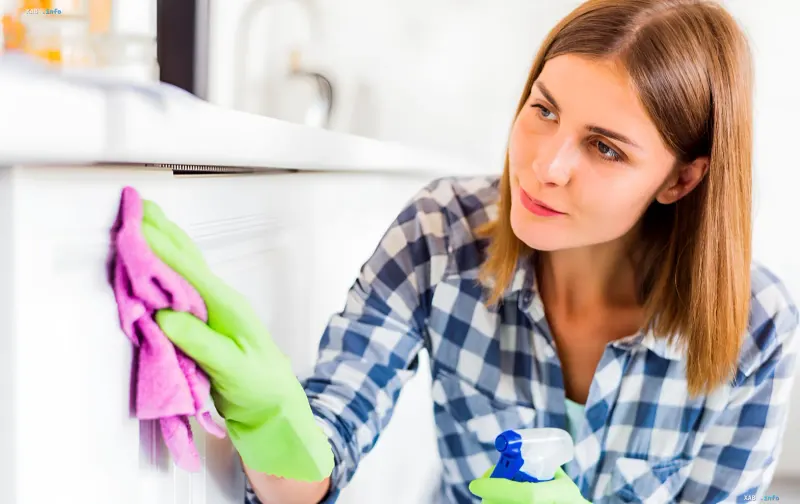
Fat on kitchen facades accumulates unnoticed: near the stove and hood, a thin film appears faster than we can notice it, and over time turns into a sticky and hardened deposit. The good news is that in most cases it can be removed without exhausting scrubbing and without expensive aggressive agents. Below are five working home methods, from the mildest to the heaviest, as well as rules that will help you not to damage the coating.
Soapy solution — basic and safest method
For fresh or not too old fat, warm water with a few drops of detergent is enough. Soak a soft sponge, squeeze it well and wipe the facades. If the deposit is sticky, leave the solution on the surface for a few minutes, then wipe with a clean damp sponge and be sure to dry. This is the most gentle option, suitable for most coatings and does not require preliminary testing.
Soda paste for stubborn stains
More stubborn contamination is removed by a thick paste of soda and a small amount of water. It is applied to the greasy spot and not rubbed immediately, but left for 5–10 minutes, after which it is carefully removed with a soft sponge. Important limitation: soda is an abrasive, so before use the method must be tested on an inconspicuous area. On glossy and delicate coatings it can leave matte traces or micro-scratches.
Vinegar solution and its limitations
A mixture of water and table vinegar in approximately equal proportions helps to cope with fatty deposits on durable surfaces. The solution is applied to the sponge, and not directly to the cabinet, and only then the contamination is wiped. Key warning: vinegar should not be used on natural stone and on coatings sensitive to acids — it can irreversibly spoil their surface.
Steam and melamine sponge for old grease
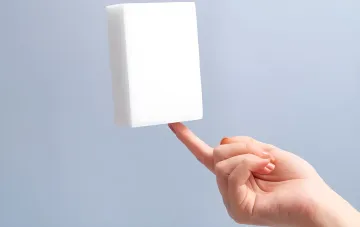
If the deposit is old and already hardened, it must first be softened. Hot steam helps: the steam attachment is held at a small distance from the area, and then the softened fat is immediately wiped with a soft cloth. Before this, make sure that the facade material tolerates moisture and heat. For stubborn traces on strong surfaces, a melamine sponge is sometimes used, but very carefully: it works as a micro-abrasive and on glossy, lacquered or delicate coating it can leave a matte spot or scratches. First test on an inconspicuous place and do not press hard.
Main rule — do not rub the deposit dry
Fat goes away best when it is not immediately tried to be rubbed to a state of 'like new'. First, the deposit is softened with warm water or a suitable agent, left to act for a few minutes and only then the surface is wiped. This approach makes cleaning noticeably faster and reduces the risk of damaging the facades. By following the sequence — from mild agents to more aggressive ones and with a mandatory test on an inconspicuous area — you can return the kitchen cabinets to their shine without expensive chemicals.