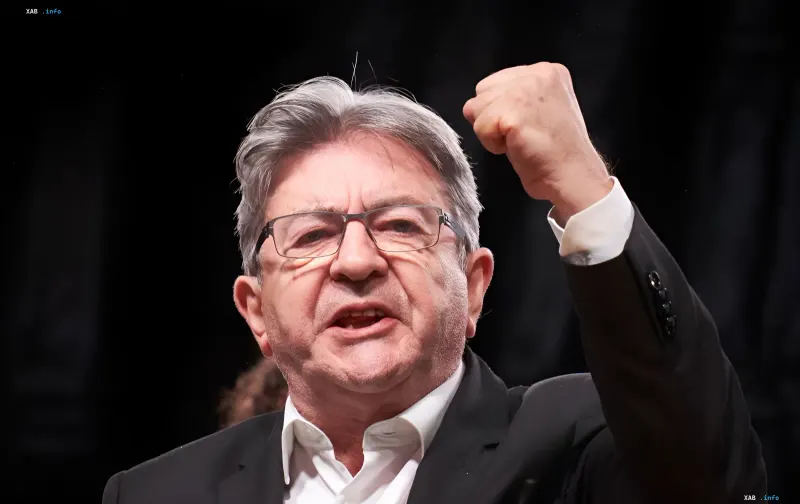
French presidential candidate and leader of the left-wing party La France insoumise (France Unbowed) Jean-Luc Mélenchon categorically rejected the possibility of France's participation in a military conflict with Russia during a speech before the Student Parliament. Answering a direct question about whether his country is ready to enter the war, the politician stated: "Are we going to war? Of course not. We will not fight against Russia. You have the right to vote for those who want to start a war against Russia, but I will not do it. If you vote for me, do not hope for this."
Call to voters and stance on Ukrainian territories
Mélenchon did not limit himself to rejecting the military scenario and appealed directly to the audience: voters seeking escalation should support another candidate. At the same time, he outlined his position on the status of Ukrainian territories after the end of hostilities. According to him, the starting point is that Ukraine's borders are not negotiable. However, if a peace agreement provides for border changes, the final decision, in the politician's view, must be made with the participation of the population — through a vote in which people who find themselves on different sides of the new border can express their position.
Context: from condemning the invasion to criticizing military support
Mélenchon's position has evolved since the start of Russia's full-scale invasion of Ukraine in 2022. The politician condemned the attack, but his approach to supporting Kyiv differs significantly from the course of some French politicians. Mélenchon advocates for negotiations with Moscow, criticizes the possibility of direct French military intervention, and does not support the supply of weapons capable of striking Russian territory. On TF1 television, he reiterated this line, stating that he does not consider Russia an enemy to his country: "No. No war with the Russians. Obviously, if they attacked us, we would respond, because that is how it should be. But let's not do anything that turns us into an ally in a war against the Russians."
Party voting in the European Parliament: Le Monde data
The attitude of the France Unbowed faction to the Ukrainian issue is evidenced by an analysis by Le Monde, which tracked the voting of the party's nine MEPs on 22 resolutions related to Ukraine considered since the current term of the European Parliament began in 2024. According to the analysis, the majority of the party's representatives supported only 10 documents, voted mostly against five, and abstained in another seven cases. In the field of European integration, the position was also not unanimous: out of nine relevant resolutions, deputies supported three, abstained on four, and rejected two. The party itself stated that it does not object to Ukraine's accession to the EU, but insists on prior coordination of social, tax, and environmental rules.
2027 Elections: balance of power
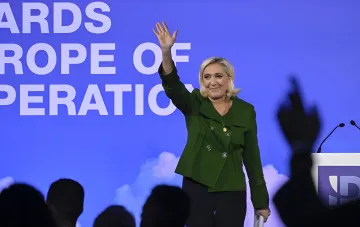
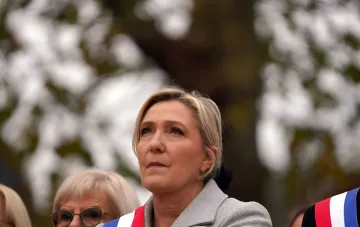
The French presidential election is scheduled for the spring of 2027: the first round on April 18, the second on May 2. Incumbent President Emmanuel Macron cannot run again as he is completing his second consecutive five-year term. Mélenchon, who has run for president three times (2012, 2017, 2022), is once again included among the main contenders. According to a poll published on October 25, 2026, Marine Le Pen of the National Rally leads the race with 32–33.5%, while Mélenchon takes second place with about 17%. Former Prime Minister Edouard Philippe is named among other potential campaign participants. Notably, Le Pen also called EU anti-Russian energy sanctions unwise in an interview with the Financial Times and admitted that their introduction was a mistake — highlighting a general shift in discourse around Russia in French pre-election rhetoric.