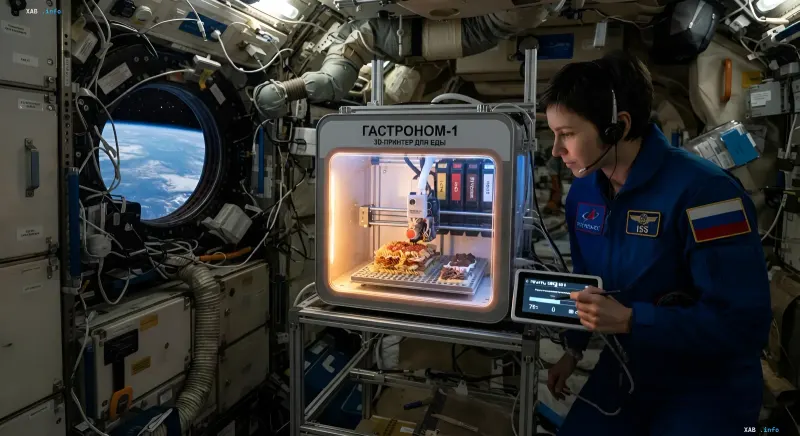
Russian engineers and technologists have begun shaping the concept of a 3D printer designed to directly print food products on board spacecraft and orbital stations. Andrei Vedernikov, Head of the Space Food Department at the Research Institute of Food Concentrate Industry and Special Food Technology, told TASS about this. According to him, the project is at an early stage: the team is defining the technical requirements for the device and assessing the real capabilities of the future system. Images accompanying the publication show a device labeled 'GASTRONOM-1' — a food 3D printer operating in conditions simulating a spacecraft interior.
Weightlessness and No Refrigerator: The Main Engineering Barriers
The key complexity of the project, according to Vedernikov's assessment, lies in the need to adapt the technology of layer-by-layer deposition of food masses to microgravity conditions. In weightlessness, liquids and paste-like components behave fundamentally differently than on Earth: they do not flow down, are not held on the surface without special mechanisms, and crumbs and dry fractions move freely within the cabin volume. In addition, the printer must work with ingredients capable of long-term storage without refrigeration equipment. This imposes strict limitations on both the chemical composition and release form of the raw materials, as well as the design of the device itself — from cartridge tightness to the dosing system.
Phased Strategy: From Earth Restaurant to Orbit
The development, Vedernikov emphasized, will be carried out in stages. At the first stage, the technology is planned to be tested in terrestrial conditions, including in operating restaurants, where the 3D printer will be used to prepare dishes under standard gravity. Only after working out the main engineering solutions and confirming the stability of the process will the team consider transferring the technology to space applications. This approach reduces risks and rework costs: errors identified on Earth will not require expensive launches and orbital tests.
Context: Why Space Nutrition is Becoming a Technological Challenge
Modern orbital programs, including those operating on the International Space Station, rely on canned, lyophilized, and vacuum-packed products delivered on board in ready-made form. This limits diet variety, increases the mass of cargo modules, and shortens the shelf life of supplies. 3D food printing from compact dry or paste-like components can potentially reduce logistics volume, extend missions, and provide the crew with more diverse food. The Russian 'Gastronom-1' project fits into this trend, adding the specific task of adaptation to weightlessness.
Project Status and Prospects
Currently, according to TASS, it is a matter of forming the technical specifications and preliminary calculations. Specific timelines for orbital tests, the budget, and the list of customers are not disclosed in open sources. Nevertheless, the very fact of transition from concept to engineering development indicates that the topic of 3D food printing for space in Russia has ceased to be purely futurological and has moved into the stage of applied development.