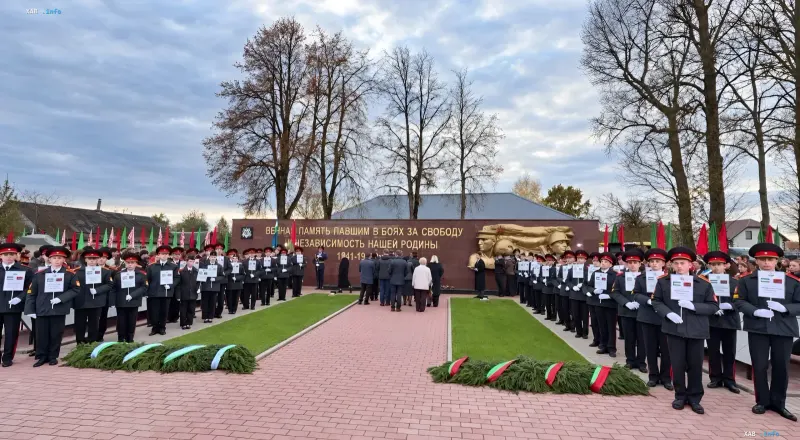
On October 15, a solemn opening ceremony for a memorial complex dedicated to the memory of soldiers from Uzbekistan who died in battles for the liberation of the Vitebsk region from Nazi invaders during World War II took place in the village of Shapuri, Vitebsk district. The event was attended by official representatives of the two states, local residents, and a guard of honor. In the foreground of the ceremony are wreaths with ribbons in the colors of the Uzbek flag and a solemn formation of servicemen near a stela bearing the inscription: "Eternal memory to those who fell in battles for the freedom and independence of our Motherland 1941–1945."
Site of decisive battles of Operation Bagration
During the war, the village of Shapuri became one of the key points for breaking through the German defense in the Vitebsk direction during the strategic Operation Bagration. It was here, according to local authorities, that one of the largest mass military graves in Belarus is concentrated. In this mass grave, according to information announced at the ceremony, about 18,000 Soviet soldiers are buried, of whom 729 are soldiers mobilized from Uzbekistan. Vitebsk District Executive Committee Chairman Sergei Yegorov emphasized that more than 1,300 Uzbek soldiers have been laid to rest across the Vitebsk land, making this burial site not only a local but also a nationwide memorial.
Appearance of the memorial and ceremony details
The memorial complex includes a bronze plaque installed on a large natural stone, capturing the feat of the Uzbek soldiers who gave their lives for freedom in both Uzbek and Russian. Nearby stands a stela with a relief image of soldiers and an inscription in Russian addressed to those who fell in 1941–1945. During the ceremony, the guard of honor in ceremonial uniforms lined up on both sides of the central pathway, and delegations laid wreaths tied with ribbons in the colors of the Uzbek flag — green, white, and red. Youth and schoolchildren held cards with the national flags of the two countries, emphasizing the educational and formative character of the event.
Diplomatic significance of the event
High-ranking representatives of both states took part in the opening ceremony. On the Belarusian side, the event was attended by the head of the Vitebsk Regional Executive Committee Alexander Rogozhnik and other regional officials. The Uzbek side was represented by the Ambassador Extraordinary and Plenipotentiary of the Republic of Uzbekistan to the Republic of Belarus Nuriddin Madzhamanov and the Khokim of the Andijan Region Shukhratbek Abdurakhmonov. The presence of the ambassador and the regional leader from Andijan — a region historically associated with the mobilization of a significant number of soldiers to the front — gives the event the character of an official interstate act of remembrance.
Symbol of shared history and friendship of peoples
The installation of the memorial in Shapuri is seen as a manifestation of historical justice and the consolidation of a shared memory of the feat accomplished during the Great Patriotic War. For Belarus, this is another confirmation that the liberation of the region from occupiers was an international cause involving soldiers from all republics of the Soviet Union. For Uzbekistan, it is an opportunity to publicly honor the memory of compatriots whose names were previously not immortalized at the site of their death. Thus, the memorial complex in Shapuri becomes not only an object of historical memory but also a symbolic element in strengthening bilateral ties between the peoples of the two countries.