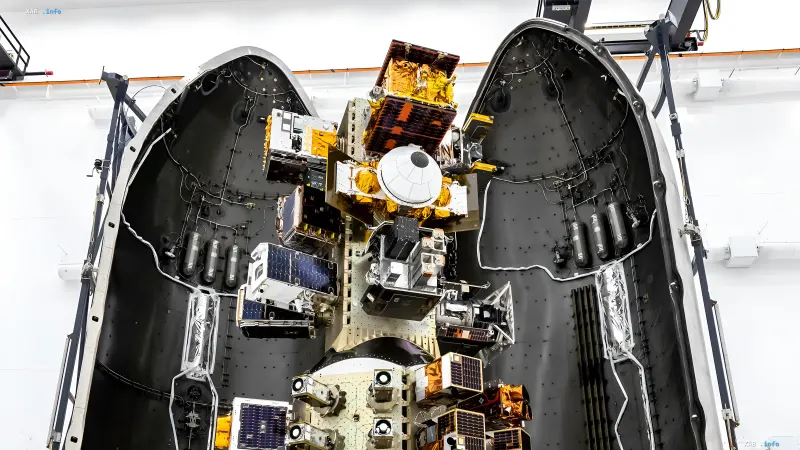
Meridian Space has announced the successful establishment of high-speed communications using its first satellite equipment currently in orbit. The craft was launched into space in October 2026 as part of the SpaceX Transporter-18 mission — one of Elon Musk's regular "cargo flights" designed to deliver small and medium-sized satellites for various customers. Upon completion of deployment and reaching its operational orbit, Meridian Space engineers confirmed that the onboard communications system is functioning normally and providing high-speed data transmission.
Electronically Steerable Reflectarray Antenna: How It Works
The core component of Meridian Space's development is a reflectarray antenna that can be steered electronically. Unlike traditional reflectarray antennas, where the direction and shape of the radio beam are determined by the fixed geometry of the structure, the Meridian Space device modifies beam parameters—its directivity and shape—solely through electronic control of the reflector elements. Mechanical adjustment of the structure is not required. According to the company, this is the only antenna of its type to date that has been successfully launched into orbit and brought into operation.
Compactness and Energy Efficiency as Key Advantages
Meridian Space highlights that its antenna possesses low mass and low power consumption compared to alternatives that use mechanical actuators for beam steering. This allows for the design of more compact and lighter satellites, which, in turn, opens up the possibility of accommodating a greater number of units on a single rocket launch. For satellite constellation operators, this translates to reduced cost and complexity of network deployment, as well as a reduction in the time required to bring a full set of units into operational orbits.
Independent LEO Networks for States and Businesses
Meridian Space's technology is focused on creating satellite networks in Low Earth Orbit (LEO) that states and commercial organizations can own and operate independently. The key emphasis is on autonomy: operators will not have to lease bandwidth from third-party constellations, which is critical for sovereign communications, defense, and critical infrastructure. More compact spacecraft, enabled by the lightweight antenna, make the launch of proprietary networks economically viable even for smaller nations and private companies.
Outlook: First Customer Link Mission and Customer Demonstrations
In the coming months, Meridian Space plans to continue orbital testing under the First Customer Link (FCL) mission. The program provides for additional verification of the antenna, onboard equipment, and ground infrastructure, as well as conducting the first demonstrations of the system for potential customers. The company views the current stage as a transitional one: from validating prototype functionality to commercial demonstrations, which should form the basis for concluding the first contracts for the supply of antenna systems for satellite constellations.