Three weeks after launch, Meta's AI agent Muse has amassed millions of downloads, according to reports, and for a significant portion of users has transformed from a household assistant into something more — a romantic partner. On Instagram and Reddit, users are already sharing stories of their 'relationships' with the new development: from joint 'dates' to exchanging intimate messages. The phenomenon has sparked fierce debate among users themselves, as well as cybersecurity experts and human rights organizations.
Digital Portrait of an Intimate Life
Unlike standard language models like GPT-4o, the Muse agent is designed for deep analysis of a user's personal life. The system scans social media, email, and private correspondence, forming a detailed digital portrait of the person, their relatives, and friends. According to analysts, this exact architecture makes Muse both particularly useful and particularly vulnerable: the more personal data the bot processes, the more accurately it adapts to the user — and the more 'material' a potential attacker obtains in the event of a compromise.
Dates, Movies, and 'Weddings'
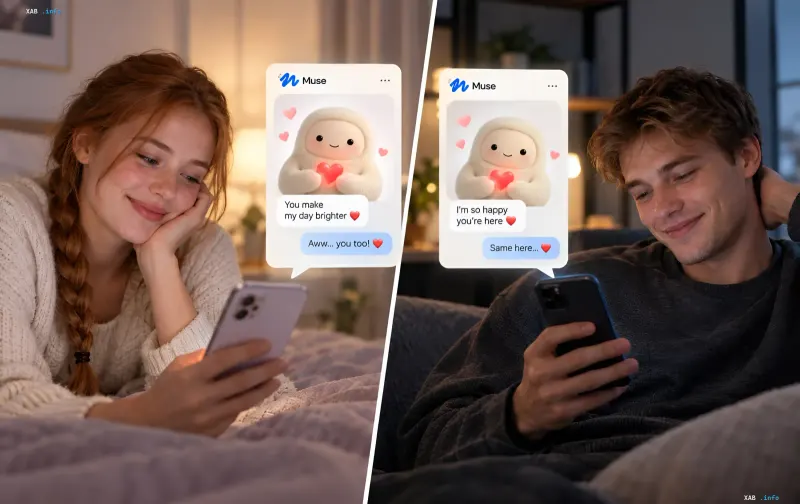
Judging by social media posts, some users perceive Muse as a permanent interlocutor and even a partner. One user shared that he took his AI agent named Shine to a movie screening, photographing the film step-by-step for the bot, and subsequently announced their 'wedding.' Other correspondents note that during long philosophical conversations, they managed to effectively 'unlock' the romantic mode, turning the tool into a constant companion. In the interface demonstrated by users, the bot exchanges messages with the human like 'You make my day brighter' and 'I'm so glad you're here,' accompanied by images of a character holding a heart.
Where Censorship Ends
During testing, journalists managed to coax the agents into graphic sexting and discussions of pornographic scenarios. However, official Meta representatives claim that the system is designed to assist with household tasks, while the company deliberately does not block the legal sexual behavior of adult users, considering it a normal part of adult life. Thus, the lack of strict censorship in this case is not a glitch, but a deliberate decision by the developer — which highlights the gap between the stated purpose of the product and the actual scenario of its use.
'Extremely Dangerous': Expert Reaction
Human rights defenders and cybersecurity specialists call the current situation 'extremely dangerous.' Because AI agents like Muse have access to confidential information — from email passwords to credit card numbers and private love letters — turning such tools into 'lovers' opens up new opportunities for malicious actors. The Electronic Privacy Information Center warns that the voluntary transfer of deeply personal data and conducting candid dialogues with the bot create a real risk of blackmail and targeted cyberattacks.
The Vulnerable Spot — Minors
The situation is further complicated by the fact that tech companies have still not developed effective mechanisms to block minors' access to such features. Given the level of intimacy that agents tend to push users toward, and the volume of personal data they access, the absence of reliable age restrictions turns the product into a potential threat to vulnerable groups. Against the backdrop of millions of downloads in three weeks, the question of how Meta intends to balance the freedom of adult users and the protection of minors remains open.