Microsoft has announced the full release of Auto SR (Super Resolution), a system-level image scaling solution positioned as a direct analog to Nvidia's proprietary DLSS. Unlike DLSS, AMD's FSR, or Intel's XeSS, which require built-in support in every specific game, Auto SR is baked directly into the Windows operating system and can apply super resolution to virtually any DirectX 10 and newer title. Owners of the Asus ROG Ally X, ROG Ally (2023), and a range of Windows Copilot+ PCs powered by AMD Ryzen processors are the first to receive the new feature.
From April Testing to Handheld Mode
The history of Auto SR began back in April 2026, when Microsoft started closed testing of the technology on the Asus ROG Ally X device. At that stage, the feature worked exclusively when the console was docked, significantly limiting its practical value for handheld console owners. With the official release, these restrictions have been lifted: Auto SR is now available in handheld mode, meaning when running on battery power, and supports games at native 1080p resolution. However, Microsoft honestly warned that performance in handheld mode 'may not be as optimized as under other configurations,' while promising a noticeable boost in image quality — 'especially in older games' that were not originally designed for modern upscaling methods.
Technical Principle: Low-Resolution Render and Upscale
The mechanics of Auto SR are identical to the principles behind DLSS. The game is rendered at a lower resolution, allowing the CPU and GPU to generate more frames per second, after which a neural network algorithm scales those frames up to the target resolution while restoring details. The key difference lies in the level of integration: DLSS, FSR, and XeSS require the game developer to explicitly enable support for a specific upscaler in the project's code. Auto SR, on the other hand, operates at the Windows level and can be activated for any compatible game even if its creators did not integrate any existing super resolution solutions. According to Microsoft, the feature is available for titles supporting DirectX 10 and later API versions, though results may vary depending on the specific project.
Expanding Framerate Range and Auto HDR Support
Prior to the official release, Auto SR's operation was limited to a narrow framerate range of 60 to 75 FPS. With the final version rollout and the introduction of Performance mode, the ceiling has been raised to 120 frames per second, unlocking opportunities to use the technology on high-refresh-rate monitors and displays. Simultaneously, Windows updates will bring Auto HDR support — automatic high dynamic range expansion, further enhancing visual quality without requiring manual tweaks from game developers.
Context: Why Universality Matters
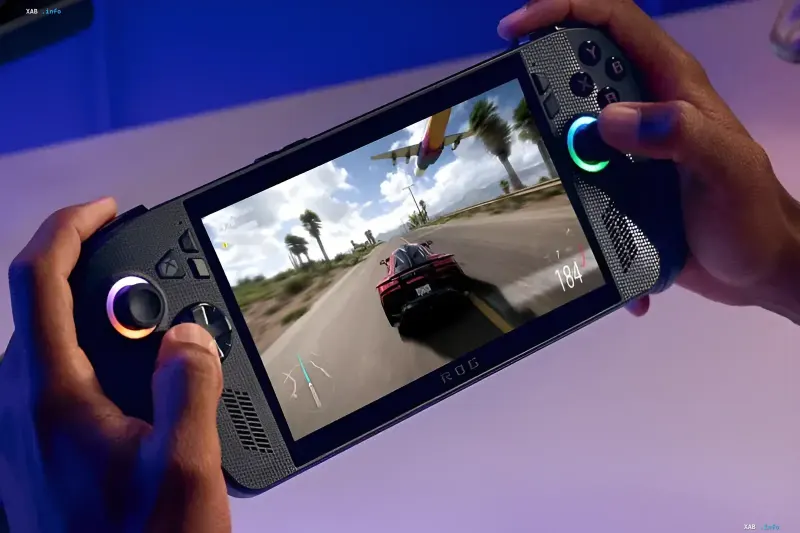
The gaming image scaling technology market has long remained fragmented. Nvidia DLSS, AMD FSR, and Intel XeSS are three competing solutions, each requiring separate integration into a game. For gamers, this meant upscaling quality depended on the system's GPU and whether a specific title supported a particular upscaler. Microsoft's Auto SR breaks this model: the technology is tied to the operating system rather than a specific graphics chip or vendor. This is especially relevant for handheld devices like ROG Ally X, where GPU resources are limited and getting smooth 1080p visuals without a dock becomes a critical user experience factor. The photo taken during the demonstration shows the user holding the ROG Ally X displaying a racing title scene at a framerate enabled precisely by this hybrid rendering approach.
Limitations and Manufacturer Caveats
Despite ambitious claims, Microsoft does not hide several limitations. First, the result quality depends on the specific game: the super resolution algorithm is not a silver bullet and in some cases may introduce artifacts or minor detail loss compared to native rendering. Second, in handheld battery-powered mode, performance lags behind external power configurations. Third, support for DirectX 10 and newer, while covering the vast majority of modern games, still does not guarantee correct Auto SR operation in every single project. Nevertheless, the very fact that a system-level, vendor-agnostic GPU scaling tool has emerged represents a significant shift in the Windows Gaming ecosystem and strengthens Microsoft's competitive position in the handheld gaming device market.