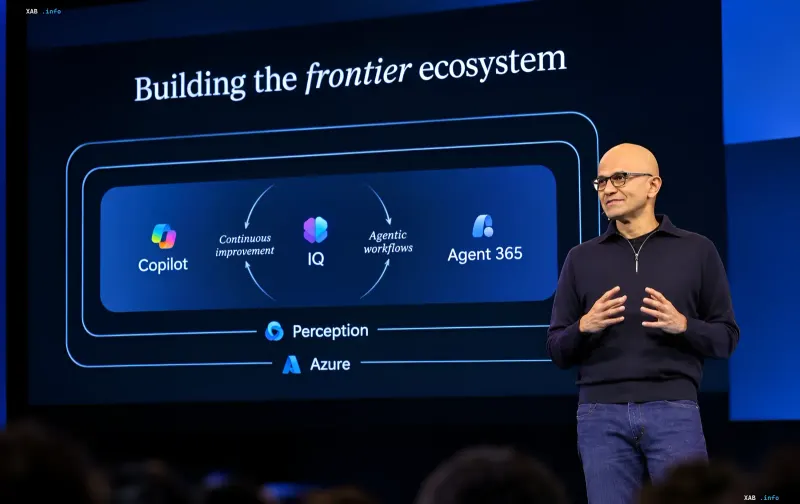
At the Ignite conference, Microsoft CEO Satya Nadella introduced a concept that changes the very logic of working with the office suite: instead of opening individual applications, the user now interacts with an AI agent, while the familiar Word, Excel, and PowerPoint act as tools for it. As shown in the presentation slides titled "Building the frontier ecosystem," three components—Copilot, IQ, and Agent 365—stand at the center of the new architecture, united by cycles of "continuous improvement" and "agentic workflows," with Perception and Azure layers lying beneath them. According to the company, this is a radical shift: the workflow is built around an AI agent, not around a separate program.
Documents, spreadsheets, and presentations within Copilot
The practical meaning of the innovation is the ability to create documents, spreadsheets, and presentations directly in Copilot without switching between applications. According to Microsoft, when the AI assistant launched, the underlying models were not powerful enough to control applications: it could only answer questions. Over the past year, the company claims, technologies have made a leap, and Copilot is now capable of performing multi-step edits, understanding the depth of Excel pivot tables, PowerPoint animations, and Word citations, while the user maintains control over changes and settings for style and branding.
Autopilot, Work IQ, and collaborative workspaces
The key announcement was Copilot Autopilot—a cloud-based autonomous agent for personal productivity to which whole tasks can be delegated, rather than individual actions, such as managing email and calendars. It will operate on a credit basis (Copilot Credits), and the exact cost will be announced later. In parallel, Microsoft introduced the intelligent platform Work IQ (part of Microsoft IQ), which analyzes internal communications, employee connections, and projects, forming a unified contextual layer for agents, as well as Copilot Workspaces—a collaborative environment that moves interaction with AI from single-user mode to a team mode, where people and agents work toward a common goal.
Access and licensing: what has changed
Important context is provided by the licensing policy Microsoft has been building throughout 2026. Reportedly, Copilot has become available to Microsoft 365 subscribers, and for commercial clients, starting April 15, 2026, full Copilot functionality in Word, Excel, PowerPoint, and OneNote is reserved for users with a paid Microsoft 365 Copilot license, while basic Copilot Chat in these applications is limited for users without such a license. Copilot in Outlook, according to the company, continues to work by linking to incoming messages and the calendar. Thus, the new agent layer at Ignite builds upon the already existing paid access model for businesses.
Trust and security: rejecting AI 'self-governance'
Nadella paid special attention to trust and security, openly stating that the internal processes of generative models remain complex to fully understand and that autonomous systems cannot be trusted unconditionally. The company's architectural response was to reject AI self-governance in favor of strict control: every Autopilot agent receives a unique identifier, administrators can restrict its permissions or block them entirely, all actions are logged for human audit, and the system is required to request confirmation before critical steps.
Transparency initiative with 40+ companies
Beyond internal mechanisms, Microsoft has launched an "AI Transparency Initiative" in partnership with over 40 industry companies, including Adobe and Mastercard. Its goal is to develop open and unified security standards for autonomous AI systems. The combination of announcements—from an agentic workspace to a credit-based payment model and external trust standards—indicates that Microsoft is positioning Copilot not as an add-on to the office suite, but as an independent environment where classic applications become tools for agents.