Microsoft has officially announced a multi-year agreement with the Intel Foundry division, becoming the first company to confirm the use of EMIB (Embedded Multi-die Interconnect Bridge) packaging technology for its custom semiconductor solutions. The partnership spans not only die packaging, but also multi-year supplies of Intel Xeon server processors for the Azure cloud infrastructure, as well as joint development on Compute Express Link integration and hardware security mechanisms. Essentially, this marks one of the first major cases where a major cloud provider delegates a key manufacturing stage of its own chips to an external foundry division rather than merely purchasing off-the-shelf processors.
EMIB-T: Vertical Power Delivery for 3D Modules
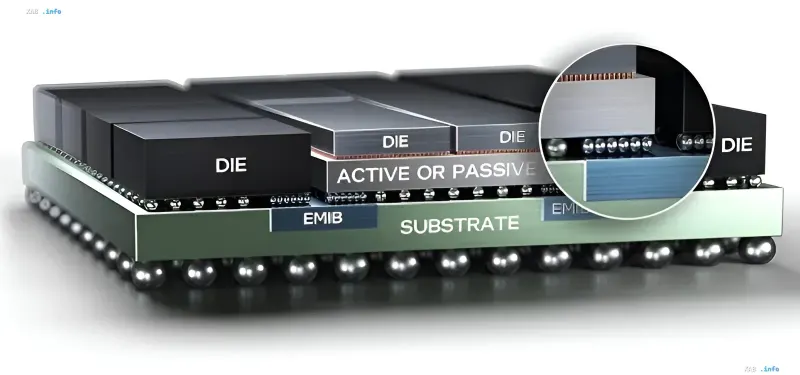
At the core of the agreement's technological component is the EMIB-T modification, which complements the classic bridge structure with Through-Silicon Vias (TSVs). This ensures vertical power delivery to multiple stacked dies within a single module, which is critical for 3D stacked architectures. The schematic published with the announcement clearly shows a multi-layer design: the top active or passive dies (DIE) connect via microscopic solder bumps to the substrate (SUBSTRATE), while EMIB bridges form a dense inter-die connection. This exact architecture allows an accelerator and logic blocks to fit into a single package without sacrificing interconnect density.
Maia 200 and Cobalt 200: Chips Heading to Intel Production
Microsoft's proprietary chip portfolio mentioned in the statement features two families of specialized processors. Maia 200 accelerators target AI inference workloads, including complex reasoning processes, while Cobalt 200 processors are optimized for intelligent agents. Future generations of both families will be manufactured using Intel Foundry packaging technologies, including EMIB and its EMIB-T variant. Thus, Intel secures not a one-time order, but a multi-year program tied to the roadmaps of both Microsoft chip lines.
Xeon 7, CXL, and Flat Memory Mode: What Azure Gets
In addition to packaging its own chips, Microsoft has guaranteed multi-year supply volumes of Intel Xeon server processors, including upcoming Xeon 7 models codenamed Diamond Rapids. The companies will jointly work on integrating Xeon with the CXL interface, which, according to Microsoft estimates, has already increased memory performance and flexibility in Azure M v4 series virtual machines by up to 2.3x on current Xeon 6 processors running in Intel Flat Memory Mode during resource-intensive workloads. This is a crucial signal for data centers: CXL is transitioning from an experimental add-on to a standard memory scaling mechanism in cloud hyperscale infrastructures.
Security and Acceleration: Intel QAT and TDX in the Cloud
A separate block of the agreement involves the deployment of Intel QuickAssist Technology (QAT) hardware acceleration and Intel Trust Domain Extensions (TDX) confidential computing tools. Launching the first cloud virtual machines with QAT support, according to Microsoft, accelerated SQL database backups by up to 2.5x and increased operational reliability. TDX technology, in turn, provides encryption for virtual machine memory and processor register states during the migration of confidential VMs between physical hosts, which is especially critical for multi-tenant cloud environments where client data isolation is a mandatory requirement.
Stakeholder Perspectives: 'Heterogeneous Integration Flexibility' and 'Customer Workloads'
Naga Chandrasekaran, Executive Vice President and General Manager of Intel Foundry, emphasized that the partnership combines 'the flexibility of heterogeneous integration with the manufacturing scale required for the AI era,' and that Azure customers will 'experience a qualitatively new level of performance and economic efficiency.' Saurabh Dighe, Corporate Vice President of Azure Systems and Architecture at Microsoft, added that the multi-year collaboration 'brings together advanced packaging, specialized compute, memory, and security features to advance Azure cloud platforms.' Both sides stress that this is not a one-off deal, but a systematic optimization of the entire chain—from silicon and packaging to software and memory management.