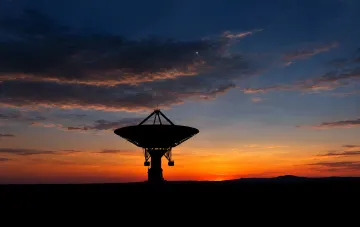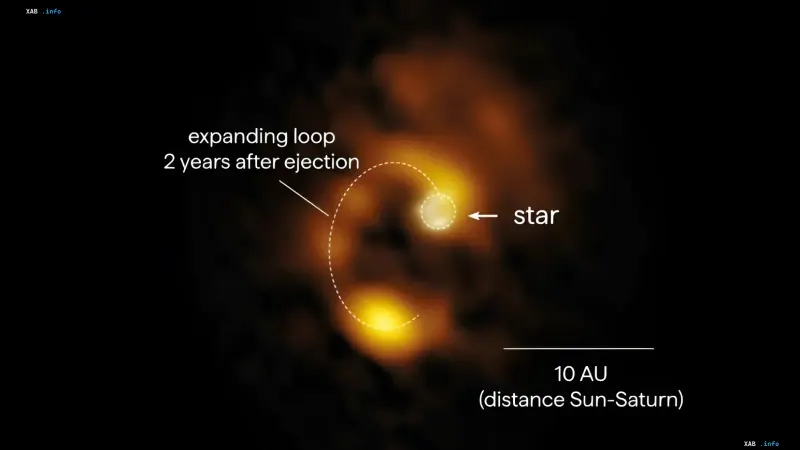
Astronomers have captured a giant gas loop around Mira A, a red giant star located 330 light-years from Earth, which formed following a powerful flare on the star's surface. The structure was imaged in 2025 using the ALMA radio telescope in Chile. Spanning approximately 10 AU—the distance from the Sun to Saturn—the ejection is one of the most detailed examples of stellar outflow ever observed on a red giant.
A Decade of Observation and the 2023 Flare
A team led by Wouter Vlemmings and Miora Andriantsaraza from Chalmers University of Technology (Sweden) monitored Mira A for nearly a decade. During this time, the researchers documented continuous changes on the star's surface and linked the brightest regions to powerful flare events. The researchers estimate that the brightest observed flare exceeds all those previously recorded in similar stars. It was in 2023 that a bright region appeared on Mira A's surface, serving as a prologue to the formation of the massive gas structure.
Giant Gas Loop and ALMA Imagery
Within two years of the flare, an expanding gas loop formed around the star, which was captured in detail by ALMA in 2025. Observations confirmed that the ejection maintains a distinct loop shape and moves through space at a speed typical of a red giant's stellar wind. The scale of the structure, around 10 AU, is comparable to the distance between the Sun and Saturn, providing a clear visual representation of the event's energetic scale.
Magnetic Field as a Driving Force
The gas loop itself was the key detail of the study. ALMA observations revealed a strong magnetic field within it, and an analysis of radiation polarization allowed researchers to trace its structure. The shape of the ejection, its movement patterns, and magnetic characteristics indicate a direct link to the flare on Mira's surface. The mechanism resembles a coronal mass ejection on the Sun, but occurs on a star that is significantly larger and releases significantly more energy.
Why This Shifts Our Understanding of Stellar Wind
This study is crucial for understanding stellar wind—the stream of matter that aging stars gradually eject into surrounding space. Previously, the primary mechanism was thought to be light pressure on the matter in the star's outer layers: radiation accelerates particles, which then pull the gas along with them. Observations of Mira A show that magnetic fields are also capable of driving mass ejections and influencing the nature of stellar wind, supplementing and in some cases dominating over light-driven momentum.
Significance for Star Evolution and New Worlds
Such ejections return elements to the interstellar medium—including carbon, oxygen, and nitrogen—from which new stars and planets are formed. These data expand the picture of how red giants lose mass and enrich the galaxy with heavy elements. However, as the authors note, current observations directly show events on Mira: the extent to which magnetic ejections determine mass loss in other red giants remains to be established through future research.