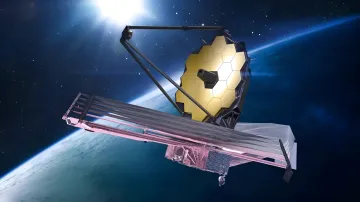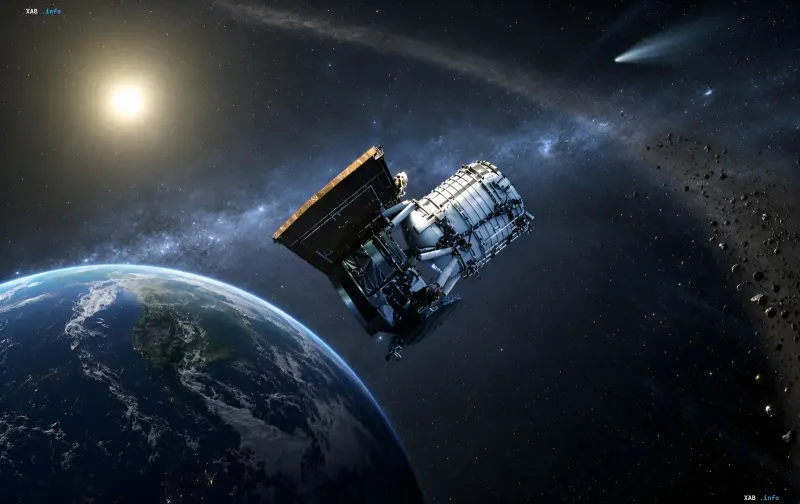
Astronomers have likely recorded for the very first time in observational history the moment a dying star consumes its companion. This unusual phenomenon was detected in the binary star system Bao within the Andromeda galaxy, located 2.5 million light-years from Earth. The research results have been published in the scientific journal Nature, RBC-Ukraine reports. The discovery was made possible by combining data from several space-based and ground-based telescopes, including NASA’s NEOWISE spacecraft, California’s WINTER telescope, and the James Webb Space Telescope.
A Red Giant That Began "Accelerating" Back in 2018
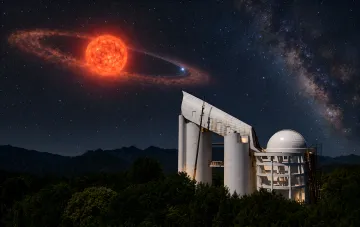
The central object of the study was the red giant WNTR23bzdiq in the Andromeda galaxy. The mass of this star is approximately seven solar masses, and its diameter exceeds that of the Sun by more than 350 times. In 2023, scientists analyzing data from NASA’s NEOWISE space telescope and the WINTER telescope in California noticed that the giant’s brightness was growing anomalously. A retrospective analysis showed that a gradual increase in luminosity had actually begun in 2018. Researchers suggested that the cause was the spiral approach of the companion toward the giant's core: the friction of interstellar matter during such an approach generated additional heat and radiation.
A Flare in Late 2025 and Webb’s Observation 47 Days Later
The pivotal moment of the observations was a powerful flash of light recorded in late 2025. According to the authors, the flash occurred at the exact moment when the companion star, weighing about 70 percent of the Sun's mass, crashed into the core of the red giant. Calculations indicate that the collision may have ejected between 0.1 and 0.2 solar masses of material. Just 47 days after the flare, NASA's James Webb Space Telescope observed the system, allowing scientists to obtain additional data on the aftermath of the event and confirm the merger hypothesis.
Study Lead Allows for an Alternative Scenario
Viraj Karambelkar of Columbia University, who led the work, emphasizes that despite the evidence indicating the merger of the two stars in the Bao system into one, another scenario is still possible. To definitively determine the nature of the event, he notes, observations of the system must continue after the effects of the flare completely subside. Karambelkar also points out that capturing such an event is extremely difficult, as its manifestations against vast spatial scales are subtle, requiring highly sensitive telescopes capable of long-term sky monitoring.
Prospects: The Roman Telescope and Rubin Observatory Will Uncover New Events
The researcher expresses confidence that future observational projects will reveal significantly more such events. In particular, the Nancy Grace Roman Space Telescope and the Vera C. Rubin Observatory on the ground, equipped with a wide-field camera, will be capable of systematically scanning the sky and detecting rare episodes of star consumption in binary systems. This will open a new chapter in studying the final stages of stellar evolution and the mechanisms governing the structure of binary and multiple star systems throughout the universe.