In August 2026, Mitsubishi Motors continues to strengthen its position in the commercial vehicle market by offering an updated version of the legendary L200 pickup. The new vehicle, which marks the 45th anniversary of its first appearance, is the result of years of work by the company's engineers. Over this time, the world has seen several million units across five generations, officially sold in more than 150 countries. In this article, we will examine what has changed in the sixth-generation pickup compared to its predecessor and how much the hero of our test costs.
Design and Dimensions: From Soft Lines to Rugged Forms
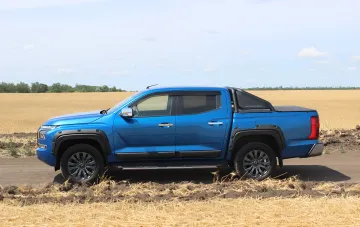
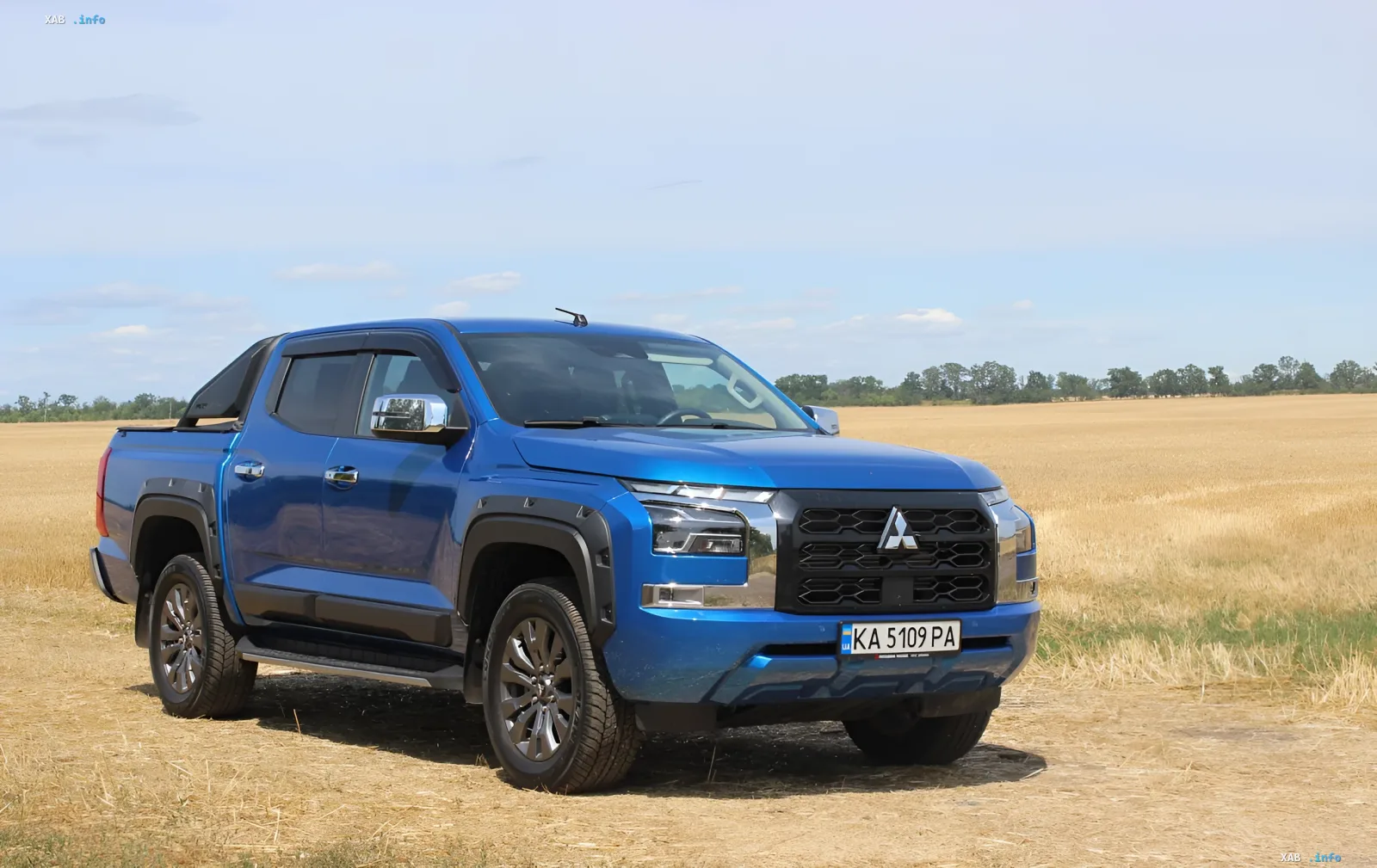
Flirting with streamlined shapes and soft lines is a thing of the past: the new L200 has become more "square" and rugged. The windshield is positioned closer to vertical, and many elements have become larger and more massive, including door handles, running boards, and even the fuel tank flap (which still holds 75 liters). The premiere of the new pickup took place about two years ago in the model's homeland, Thailand, where the main factory is located. In the local market, the L200 is sold under the name Mitsubishi Triton.
Construction and Materials: Strength and Lightness
The new pickup is fully developed by Mitsubishi Motors, as this market segment is assigned to them within the Renault-Nissan-Mitsubishi alliance. The lineup still offers three cab options – Single Cab, "one-and-a-half" Club Cab, and Double Cab. At the same time, the novelty is noticeably larger than its predecessor. For example, the wheelbase has increased by 130 mm – up to 3130 mm. The dimensions of the only version available in our market with a double cab and all-wheel drive are as follows: length – 5360 mm (plus 135 mm), width – 1930 mm (plus 115 mm), height – 1815 mm (plus 40 mm).
Ultra-high-strength steels (up to 1180 MPa in the front door sills) were used in the body construction, making it lighter. The ladder-frame construction has been retained, but the new frame is made of stronger steel and has an increased cross-section of the rails (plus 65%). Frame rigidity in bending has increased by 40%, and torsional rigidity has grown by 60%. The center of gravity height has decreased by 45 mm (now 820 mm), but other dimensions of the cargo bed have effectively remained unchanged. Conveniently, powerful running boards are built into the sides of the rear bumper, connected directly to the frame rails and capable of withstanding a person's weight.
Interior: Comfort and Functionality
At first glance, it becomes clear that the interior has become more spacious and more expensive – with expanded soft trim and higher-quality plastic. Fortunately for old-school lovers, this time there was no radical digitization: the L200 retained analog instruments, a "physical-button" climate control panel, and a traditional automatic transmission selector. The driver's seat is quite wide and simple in shape, but it holds the back well on rough roads. The second row features an almost flat bench. Interestingly, additional ventilation ducts for rear passengers are installed on the ceiling.
In the opinion of our editorial team, the main feature of the new "Elka" interior is the significantly improved sound insulation. Even on the highway, at speeds of 110-120 km/h, the engine and transmission are barely audible. It might seem that the engine itself has become quieter, while almost nothing has changed in the cabin. But no – even at idle, the diesel engine is well heard near the car, but inside – it is quiet. Storage space for small items, two spacious "glove boxes," huge pockets in the door cards, and a decent central armrest, although without the ability to change its position – these are quite light and convenient features. Among the noticeable drawbacks in the interior is the simple, albeit not overloaded with excessive information, dashboard.
Technical Specifications: Power and Efficiency
Under the hood of the Japanese pickup is the upgraded 4N16 engine. It has a familiar displacement of 2.4 liters. The hero of our test has 204 hp and 470 Nm of maximum torque in its arsenal. At the same time, during a week of acquaintance, the car showed that it can be quite economical. Thus, on the highway, the car's appetite ranged from 7 to 8 liters per 100 km depending on speed and the number of overtakes on the route. In the city, you can manage with 8-9 liters of diesel fuel per every 100 km.
The chassis architecture remains the same, but the suspensions themselves are different. In the front, the spring mount of the upper arms has been shifted upwards, which allowed increasing the suspension travel by 20 mm. At the rear, there is still a solid axle on leaf springs plus drum brakes. The transmission is the former six-speed "automatic." One of the car's features is the proprietary Super Select 4WD-II transmission. This is another iteration of the unchanged all-wheel drive with the ability to disconnect the front axle. The car is equipped with a viscous limited-slip center differential, which by default distributes traction in a 40:60 ratio (in favor of the rear axle), but has a hard lock. A novelty is the AYC (Active Yaw Control) system, which on off-road terrain brakes the inner front...