For a short-range air defense crew, changing positions traditionally means a loss of time and efficiency: the workstation has to be packed up, transported, redeployed, and reconfigured, leaving the unit effectively sidelined from combat operations until the equipment is fully restored. Bohdan Danyliv, head of the military department at the Serhiy Prytula Foundation, told RBC-Ukraine about this challenge. According to him, the previous method of shifting positions was comparable to dismantling and reassembling an airport control tower every single time. The solution came in the form of a mobile command post (MCP), which integrates everything necessary—workstation, communications, power supply, and equipment—so that the crew does not have to start from scratch after relocating.
What Is Short-Range Air Defense and Why Is It Needed
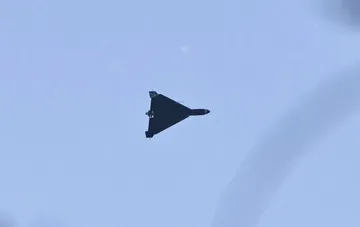
Short-range air defense is a system designed to counter low-altitude aerial targets, primarily strike and reconnaissance drones, using mobile and relatively cost-effective weapons. It includes interceptor drones, mobile fire groups, anti-aircraft installations, and detection and guidance assets. "Short-range air defense is an affordable and scalable drone protection system that complements classic air defense," Danyliv explains. According to him, these are the forces and assets primarily countering Shahed-type strike drones.
Inside the Mobile Command Post
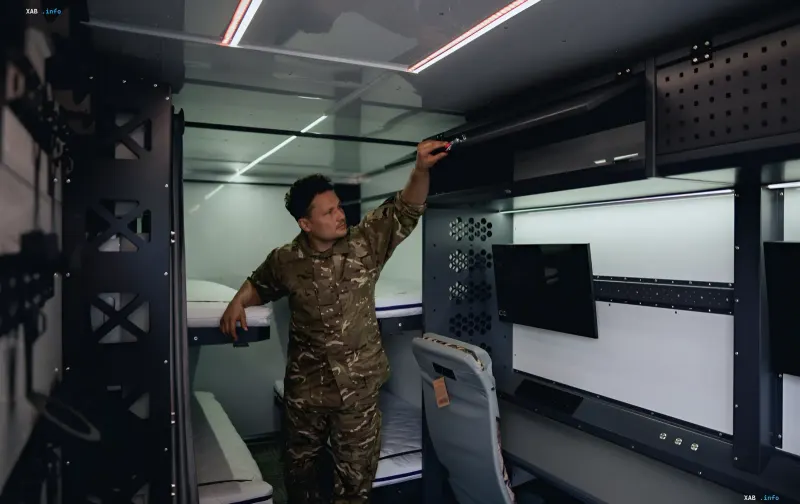
Essentially, an MCP is a vehicle with a tactical mobile trailer that houses all the equipment of the complex. Inside are laptops, monitors, drone control systems, and battery chargers. Mobile telescopic masts are provided for deploying the complex. As materials from the foundation's press service indicate, the mobile complexes consist of vans and trailers, ensuring high transport mobility.
Communications and Autonomous Power Supply
Communications within the post are organized across multiple parallel channels: Starlink, an LTE router, and a Mikrotik router. "If one channel becomes unavailable, the crew can switch to a backup, which increases communication resilience and reduces the risk of complete loss," Danyliv explains. Power is also autonomous, reducing dependence on the external power grid: depending on conditions, the system uses solar panels, batteries, and a generator. The panels charge the storage units when the sun is out, the battery ensures operation without it, and the generator serves as a backup source.
Practical Result: Less Time on Deployment, More in Combat Operations
The key outcome of introducing MCPs, according to Danyliv, is reduced deployment time, increased time spent in combat operations, and enhanced crew mobility. The unit confirms that the time required to change positions and resume operations has decreased significantly. Yuriy Andrusenko, head of the communications group for the 1020th Anti-Aircraft Missile and Artillery Brigade (AAMAB)—whose crews received five such posts—notes that the MCP can be camouflaged and used autonomously for extended periods, remaining fully operational 24/7 for several days consecutively without constant packing and unpacking. This also allows for functional separation: a separate vehicle can handle logistics, drone delivery, and searching for new positions, while the MCP itself remains directly on station. For operational security reasons, detailed implementation data is not disclosed.
The 'Tower' Travels with the Crew
An airport has planes and pilots, but they take off, land, and stay on course thanks to the control tower; in short-range air defense, the command post plays a similar role—the interceptor shoots down the target, but the system achieves the ultimate victory. In the 1020th AAMAB, such a "tower" no longer needs to be disassembled and reassembled every time: it travels right along with the crew. The context of implementing such solutions is also highlighted by broader discussions on modernizing Ukraine's air defense to counter both drones and high-speed missile targets. Concurrently, as previously reported, Ratel Robotics has begun assembling interceptor drones that can be launched from unmanned ground vehicles, while special launch boxes are being developed for enemy air target hunters.