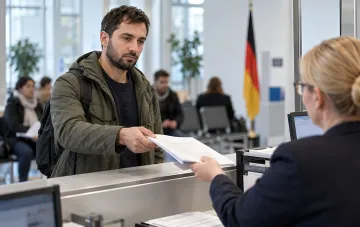
73-year-old German national Ursula Wagner was forced to turn back at the Ukrainian-Polish border on Saturday, November 14, 2026, shortly after crossing it. Following a passport check, she was informed of an active three-year entry ban for Ukraine, issued “on the basis of an order from the State Migration Service of Ukraine.” The specific reasons are not stated in the document, which DW has obtained. Wagner was forced to retrieve her suitcase from the bus she was taking to Kyiv and, accompanied by a border guard, return to the Polish border. “It was like a slap in the face, as if I had lost Savita a second time, since I cannot even visit her grave,” she told DW. “I can only explain this as a system error, because they could not give me a reason.” According to her, the border guards were “friendly” during the process.
She lost her daughter on the front line three years ago
Savita Wagner arrived in Ukraine at the beginning of Russia's full-scale invasion. Initially, she helped civilians as a volunteer, and after seeing the consequences of the occupation and the scale of crimes committed by the Russian army with her own eyes, she decided to join the Armed Forces of Ukraine (UAF). “To hell with treating symptoms — you need to eradicate the root cause,” she explained her decision in a 2022 DW interview. Before coming to Ukraine, Savita studied mathematics at university and had no combat experience. Starting in June 2022, she served as an infantry soldier and later as a combat medic in the “Carpathian Sich” battalion, which was formed as a volunteer unit but later incorporated into the UAF. In late January 2024, the 36-year-old German was killed by mortar fire during the evacuation of wounded comrades from the battlefield in the Luhansk region. Savita Wagner was buried with honors in Kyiv.
The decision to bury her daughter in Ukraine was conscious
Ursula Wagner and the deceased's widower, Karl Stenerud, decided to leave their daughter in Ukraine. “We decided it would be right to leave her next to her comrades,” Ursula Wagner explained to DW after the funeral. “She was passionate about her work, she was so dedicated that she gave her life here. Once a year, we will travel to Kyiv to visit her.” According to her, she had visited Ukraine several times before, and there had never been any problems crossing the border. This time, in addition to visiting her only daughter's grave, Ursula Wagner was to participate in an event at the Ivan Franko National University of Lviv, where a presentation of Savita’s front-line diary, published in the spring of 2026 in Ukraine and Germany, was planned. In Germany, the book made it onto the Der Spiegel bestseller list.
Border Guard Service: the circumstances of the decision are not communicated to us
The State Border Guard Service of Ukraine, which DW approached for comment, explained that a decision to ban entry into the country can be made by various authorized state bodies. “Such a decision is subsequently transmitted to the State Border Guard Service of Ukraine in the form of an order for execution at the border during border control measures,” the agency responded. “The circumstances of the decision for which a foreigner is denied entry to Ukraine are not communicated to the border agency.” Thus, the border guards who denied Ursula Wagner entry did not themselves have information about the specific grounds for the ban.
Theory of an unpaid fine: mockery or reality
According to DW sources in the Border Guard Service, the reason for an entry ban is often the non-payment of a traffic fine. In a conversation with DW, Ursula Wagner mentioned that during one of her visits to Ukraine in her personal car, she was stopped by police for speeding. It was impossible to pay the “about six euro” fine on the spot because the officers’ payment terminal was not working, and she had lost the violation report with the banking details. “Whether this could really have been the basis for a three-year ban, I can only guess: it would be a true mockery. I travel two thousand kilometers, and they send me back because of a few euros,” she said. DW has submitted a request for the grounds for the ban to the State Migration Service of Ukraine and will publish the response if it is received.