In the city of Mukachevo in Zakarpattia Oblast, a video spread across social media showing employees of the Territorial Center for Recruitment and Social Support (TCC and SS) forcibly pushing a man who had arrived with a bicycle into a minivan. The Office of the Commissioner for Human Rights of the Verkhovna Rada responded to the possible abuse of authority. This was announced by the representative of the Ukrainian ombudsman, Andriy Kriuchkov, as reported by RBC-Ukraine.
What happened in Mukachevo
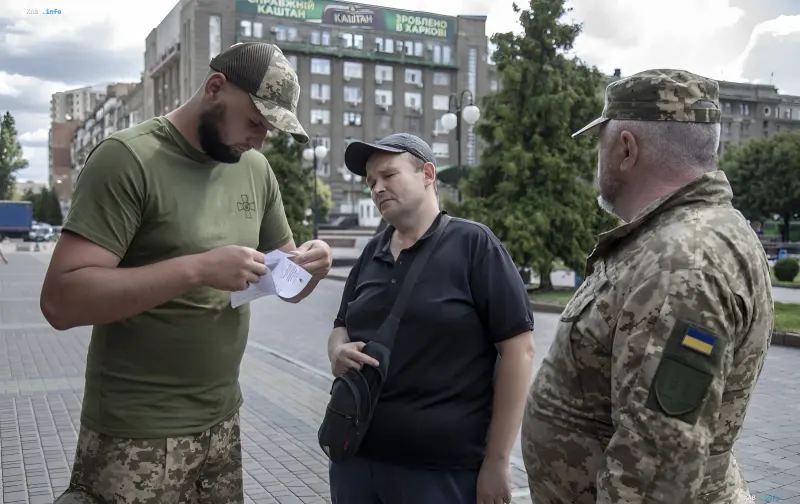
According to the footage available to the media, the incident unfolds in an open urban area: TCC and SS servicemen physically seat the man into a service minivan, despite the fact that he had been traveling by bicycle. The very fact of the use of physical force and the nature of the detention had not received an official legal qualification at the time of publication — and this is precisely what prompted the intervention of the human rights body. Other participants are also visible in the footage: near the detained man are men in civilian clothing, one of whom is examining documents at the moment the footage was captured.
The ombudsman's reaction and the course of the investigation
After the video was discovered on social media, the commissioner's representative office in Zakarpattia Oblast sent requests to three authorities: the Uzhhorod Zonal Department of the Military Law Enforcement Service, the Main Directorate of the National Police in Zakarpattia Oblast, and the Zakarpattia TCC and SS itself. Law enforcement officers were instructed to establish the legal grounds for the detention, assess the lawfulness of the use of physical force, and obtain recordings from the staff's body cameras. As Kriuchkov emphasized, if the facts of human rights violations are confirmed and the responsible officials are identified, a notice of the discovery of signs of a criminal offense will be sent to the Specialized Prosecutor's Office in the Sphere of Defense.
Contradictory data
It is important here to distinguish between two different levels of information that are often mixed together in the public sphere. First, the incident in Mukachevo is documented by a video circulating on social media, however its official legal qualification — whether this is an abuse of authority, whether it is criminally punishable — has not been established at the time of publication and is the subject of an investigation that has only just begun; in other words, the "picture" from social media and the "version" of the law enforcement officers are not yet identical and will be reconciled following the retrieval of the bodycam recordings. Second, certain high-profile criminal cases related to the TCC in Zakarpattia (including searches at the Mukachevo TCC and suspicions announced to the leadership as a result of inspections) relate to the activities of the military commissariats and their leadership and are not identical to the street incident with the man on the bicycle. These lines of investigation should not be merged into a single fact, although they occur in the same region and point to a systemic problem.
Context: a series of incidents involving the TCC
The case in Mukachevo is not isolated. Recently, a number of high-profile events involving TCC and SS staff have been recorded in Ukraine. Thus, in Dnipro, near a gymnasium, a conflict arose during a document check, in which pepper spray was used, part of which landed on the school grounds. In Lviv, law enforcement officers launched an internal investigation following an incident in which a military TCC employee pushed a woman during the conduct of notification measures. Meanwhile, large-scale inspections of the activities of military commissariats are already yielding procedural results: following inspections at the TCC in Zakarpattia, criminal cases have been opened and suspicions announced to the leadership. In other regions, in particular in Mykolaiv Oblast, according to specialized media, around a dozen cases of abuse of authority are under investigation, indicating that such practices are widespread rather than isolated.
The Ombudsman's Office position on mobilization
The Ombudsman's Office separately emphasized its principled position regarding the actions of TCC representatives during mobilization. According to the body's representative, mobilization is necessary for the defense of the state, however it must be carried out exclusively within the framework of the current legislation and with the unconditional observance of human rights and dignity. Thus, the human rights body records a double standard: on the one hand, it acknowledges the legitimacy of the mobilization campaign itself, on the other — it demands that each specific detention and any use of force be checked for compliance with the law, and that the responsible officials bear responsibility, including through the Specialized Prosecutor's Office in the Sphere of Defense.