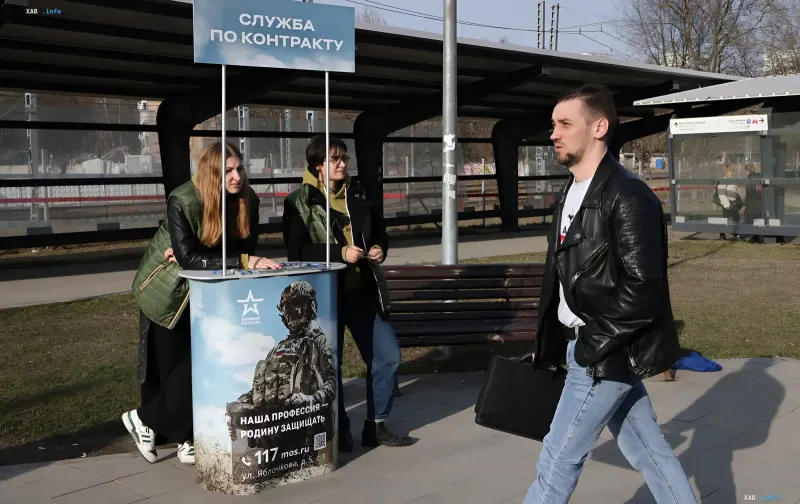
Russian citizens of conscription age are increasingly facing the inability to leave the country, and in a number of cases the fact of the restriction only becomes known to them at the moment of border control. This is reported by RBC-Ukraine, citing data from The Moscow Times and the human rights organization "Go Into the Forest." According to representatives of the organization, they are receiving appeals from people who were previously unaware of any travel ban and only learn of it when border officers refuse them entry across the border.
Scale of the Problem: 73 Appeals in Two Weeks
According to the human rights organization "Go Into the Forest," over the past two weeks 73 people of conscription age have contacted the organization, attempting to cross the Russian border. Of these, 50 were able to leave the country, while 23 were refused. In some cases, according to the applicants, the travel ban appeared directly during border control, meaning that up to that moment the people believed they had no restrictions.
"At the Border" Ban: Specific Stories
Among the recorded episodes is the case of a man who had been living in Indonesia for several years on a residence permit: he came to Russia for just two weeks but could not return, as the travel ban was already listed in the registry extract. Another applicant claims that he had not received any summonses at all, yet he was not allowed to leave a Moscow airport, and he learned of the restriction only at border control. Yet another conscript checked the registry before a Moscow–Yerevan flight and saw no ban, but at the border he was informed of the restriction; a few minutes after the refusal, a recheck showed that the ban had already been entered into the system. A separate case involves a resident of Novosibirsk, who learned of the existence of a summons only after he was not allowed to leave the airport.
System Glitch or Systematic Mechanism
Human rights advocates pay particular attention not only to the imposition of restrictions but also to the speed at which they are updated in border databases. In the Novosibirsk case, according to the applicant, the military commissariat lifted the restriction, yet just two days later the man was again not allowed to leave the country — the ban, he claims, continued to appear in the border officers' system. This points to a possible technical or organizational mismatch between the data of military commissariats and the border service.
Background: Ghosts of a New Mobilization
The situation with travel bans is unfolding against the backdrop of rumors about a possible new mobilization in Russia after the September elections to the State Duma. Analysts at the American Institute for the Study of War (ISW) had previously pointed to Russia's preparations for a new mobilization; a similar scenario was not ruled out by representatives of Western intelligence services, as well as by some European officials in conversations with The Washington Post. According to the publication's sources, the Kremlin may consider mobilization due to significant losses of the Russian army at the front. According to the Center for Strategic and International Studies (CSIS), Russian forces have lost at least 1.4 million people in Ukraine, including the killed and the severely wounded who are unable to return to the ranks. RBC-Ukraine previously reported that record queues are forming at the border with Georgia, reminiscent of autumn 2022, and that complaints of forcible detention and coercion to sign a contract with the Ministry of Defense were coming from 17 regions of the Russian Federation.
Contradictory Data
It is important to distinguish between confirmed facts and speculative context. The specific cases of refusal to leave and the data of the organization "Go Into the Forest" (73 appeals, 50 who left, 23 refused) are documented and have been passed through the chain The Moscow Times — RBC-Ukraine. At the same time, the new mobilization itself has not been officially confirmed by the Kremlin and remains at the level of rumors and assessments by Western analysts. The figure of 1.4 million losses is an estimate by a single research center (CSIS) and is not supported by independent cross-confirmation; Russian officials do not publish public data on losses. Thus, the fact of travel restrictions for conscripts is documented, while the scale and causes (preparations for mobilization) remain a matter of assessment and are not confirmed by the state.