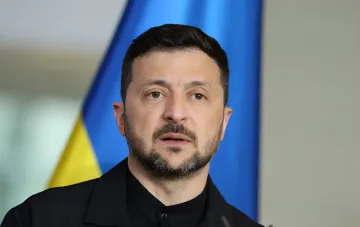
At the DealBook summit, organized by The New York Times, American billionaire and SpaceX founder Elon Musk made harsh statements against Ukrainian President Volodymyr Zelensky. According to Musk, the Ukrainian leader is allegedly "lying" when speaking about Starshield system restrictions and is intentionally blurring the lines between two fundamentally different systems—the commercial Starlink network and the military Starshield project—to use the former for offensive operations. This was reported by RBC-Ukraine with reference to summit materials.
Two systems and one confusion
Musk emphasized that Starshield is a military system, controlled exclusively by the U.S. authorities, with final decisions on its use made by the Pentagon. Starlink, by contrast, he described as a commercial project for civil users, subject to constant data speed throttling. He asserted that Zelensky ignores this distinction, positioning Starlink as a tool that can be used in combat without the knowledge or consent of the American side.
"Don't ask me to make decisions on killings"
Musk's remarks gain particular intensity from his direct address to the audience: "Don't ask me as a private individual to make decisions on killings that sometimes lead to the loss of innocent lives." Observers interpreted this as an attempt to distance himself from any accusations that SpaceX or Starlink might be used for strikes against civilian objects. By doing so, Musk shifted the responsibility for the military application of any technology to U.S. government entities rather than private business.
European reaction and context of previous statements
Musk's comments have already triggered a response in Europe. Polish Foreign Minister Radosław Sikorski previously reacted sharply to the American billionaire's claims regarding a so-called "coup" in Kyiv in 2014, stressing that there was no coup and that U.S. involvement was limited to political and humanitarian support during the Maidan protests. It is worth noting that this is not Musk's first public attack against Ukraine recently: in late October 2026, he accused Ukrainian elites of "war profiteering" and stated that American politicians use financial aid to Kyiv to fund their own election campaigns.
What this means for Starlink in the conflict zone
Musk's statements against the backdrop of the ongoing conflict in Ukraine once again raise questions about the limits of using commercial satellite networks for military purposes. The distinction that Musk himself draws—between the civilian, speed-throttled Starlink and the Pentagon-controlled military Starshield—is formally clear, yet in practice, the question of which communication channels are used in combat zones remains a subject of debate between Kyiv, Washington, and SpaceX itself. The public polemic between Musk and Zelensky, it seems, will continue.