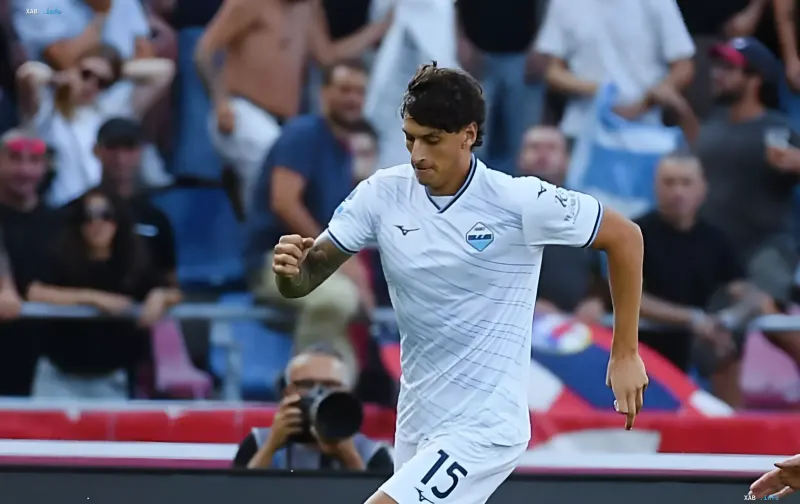
23-year-old defender Romano Floriani Mussolini made his first appearance for the senior team of Rome's Lazio in an official Serie A match. The debut took place at Bologna's home ground, the Renato Dall'Ara Stadium, where the player came on at the 19th minute to replace the injured Adam Marusic. In doing so, the great-grandson of Italian dictator Benito Mussolini inscribed his name not only in the footballing but also in the political legacy of his family.
A Historical Coincidence: His Great-Grandfather's Stadium
Floriani Mussolini's debut match was marked by a rare historical coincidence. The Renato Dall'Ara Stadium in Bologna, where the fixture was played, was personally opened by Benito Mussolini exactly one hundred years ago — in 1926. For the 23-year-old defender, this meant that his first step into elite Italian football was taken on a ground that became a symbol of the fascist regime's era. Such an intersection of the personal and the historical in a sporting context is exceedingly rare and inevitably draws the attention of the world press.
A Path from the Academy: From Loans to Debut
Romano Floriani Mussolini is a product of Lazio's academy, yet before his debut in the first team he gained match experience exclusively on loan. His record includes spells at Pescara, Juve Stabia and Cremonese, where the defender built up experience in the lower divisions of Italian football. Coming on in the match against Bologna was a logical culmination of a long journey from the club's youth system to the senior squad.
A Surname as a Burden: The Name on the Shirt
On his match shirt, the defender uses only his first name, "Romano," or the first part of his double surname with an added letter — "Floriani M." This choice avoids the direct political associations that inevitably arise when the surname Mussolini is mentioned. For a footballer whose career is tied to one of the most controversial political figures of the 20th century, the choice of name on the back of the shirt is not merely an aesthetic one but a practically necessary step.
Lazio and the Dictator: A Controversial Legacy
It is believed that Benito Mussolini and his close circle were fans of Rome's Lazio. The dictator held an official membership card for the club and, according to available evidence, regularly attended the "eagles'" matches. It is no surprise that a segment of Lazio's radical supporters, in particular the group on the Curva Nord stand, has historically shared far-right and neo-fascist ideas. This makes the appearance on the pitch of Mussolini's great-grandson in the "Biancocelesti" kit an event that goes far beyond the sporting context.
Contradictory Data
The question of Benito Mussolini's genuine attachment to Lazio remains a matter of debate among historians. On the one hand, there is documentary confirmation of the dictator's membership card and his visits to the club's matches. On the other hand, a number of researchers doubt that his political sympathy for Lazio was sincere rather than driven by pragmatic considerations or pressure from his entourage. Thus, the claim of him being a "fan" of the club appears in sources with caveats, and the final assessment of the relationship between the dictator and the Roman club remains an open question for historical science.
Worthy of separate attention is the match itself in which Floriani Mussolini made his debut: in the same game, Ukrainian forward Artem Dovbyk made his first appearance for Bologna. Thus, the match became a debut for two footballers at once, each carrying a certain historical or media resonance.