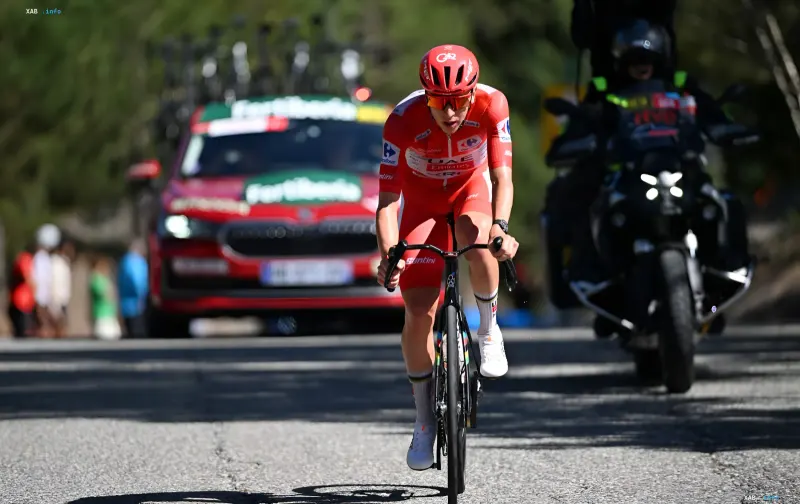
On Tuesday, 25 August, on the fourth stage of the Vuelta a España 2026, Tadej Pogačar (UAE Team Emirates-XRG) delivered his signature move — an early solo attack in the mountains — and turned it into a complete victory. The Slovenian rider did not wait for the decisive kilometres at the end: roughly 50 km from the finish he broke away from the main group of general classification contenders and held his advantage all the way to the finish in Andorra la Vella. The stage was the first truly mountainous test of this year's Vuelta: the 104.8 km distance, featuring several demanding climbs, was designed precisely for riders like Pogačar.
Solo Attack and Winner's Time
Pogačar covered the mountainous distance in 2 hours 40 minutes 35 seconds. The closest pursuer, Belgian Jarno Widar of Lotto Intermarché, finished second, 2 minutes 39 seconds behind the winner. Félix Gall of Decathlon CMA CGM took third place. A gap of more than two and a half minutes on such a short mountain stage underscores just how confidently the Slovenian controlled the race after his breakaway, leaving his rivals no real chance of catching him.
The Red Jersey and the General Classification
Winning the fourth stage allowed Pogačar to take the lead in the Vuelta 2026 general classification and don the leader's red jersey. His main rival, compatriot Primož Roglič, now trails by 3 minutes 21 seconds. Third place in the overall standings is held by Spaniard Enric Mas, who is 11 seconds behind Pogačar. Thus, after the fourth stage, the leader holds a comfortable time cushion over both of his main rivals, although more than two weeks of racing and the toughest mountain stages still lie ahead.
Contradictory Data
The sources contain a discrepancy over exactly when Pogačar took the lead in the general classification. According to Sport RBC.UA, relying on the official Vuelta website, the Slovenian "seized" the red leader's jersey on the fourth stage, meaning he did not hold it before. At the same time, RFI, reporting on the race's start on 24 August, noted that Pogačar had already been leading the general classification after the first two stages. This gives rise to two versions: either the Slovenian held the lead continuously from the start of the race and merely consolidated it on the fourth stage, or he lost the jersey on the third stage and regained it on the fourth. The official chronology of the change of leader between the second and fourth stages is not disclosed in the provided materials, so the exact dynamics of the red jersey's ownership require further verification.
The Pursuit of a "Treble"
For Pogačar, this year's Vuelta carries special significance. The Slovenian, born on 21 September 1998 and riding for UAE Team Emirates, has already won the Tour de France five times and the Giro d'Italia once, yet the Vuelta title is still missing from his collection. An overall victory would make him only the ninth cyclist in history to conquer all three Grand Tours. Pogačar returned to Spain for the first time since 2019: he made his Vuelta debut that year, winning three stages and finishing third in the general classification. Since then, his reputation as a rider capable of attacking from far away and building a huge advantage has become one of the defining factors in world cycling.
What's Next: Stage Five and the Overall Picture of the Race
The Vuelta a España 2026 started on 22 August in Monaco and will finish on 13 September in Granada; the race consists of 21 stages covering a total distance of around 3,275 km and is the third, final Grand Tour of the men's season after the Giro d'Italia and the Tour de France. Stage five will take place on Wednesday, 26 August: the riders will travel from Falset to Rocetes, covering around 173 km of hilly terrain. This stage will be less mountainous than the previous one, but with a series of climbs and descents, creating conditions both for breakaways and for the sprinter groups' battle. Pogačar's main goal now is to win the Vuelta for the first time in his career and complete his collection of victories in the world's three major stage races.