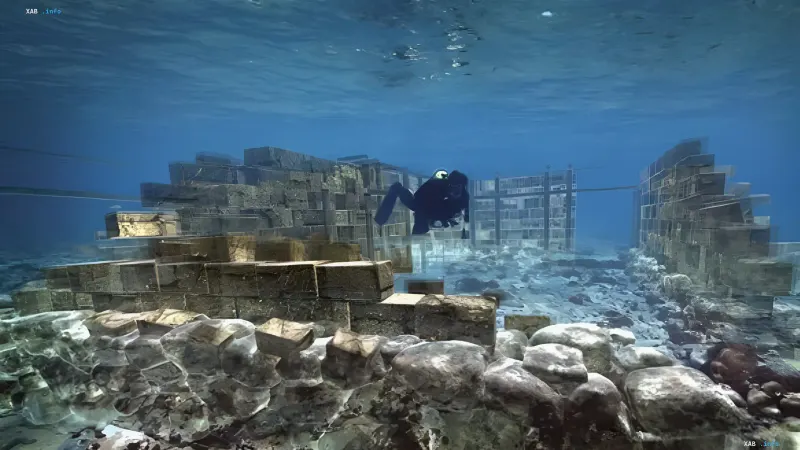
Divers off the coast of Norfolk county in the United Kingdom have made a unique discovery, exploring the remains of the medieval settlement of Shipden, which was swallowed by the North Sea about 700 years ago. The objects were found on the seabed near the modern town of Cromer. The research team managed to discover, photograph, and map the remains of 25 artificial structures that have remained underwater for several centuries.
Archaeological Finds on the North Sea Seabed
Among the discovered artifacts, massive wall-like structures made of flint, various stone buildings, and carefully hewn rock fragments stand out. Surprisingly, some of these ancient structures have partially survived to this day, despite the constant aggressive impact of the marine environment over the centuries. Experts note a high degree of preservation of the masonry for an underwater object of such age.
Противоречивые данные
Currently, scientists and researchers differ in their assessments of the exact purpose of the found underwater objects. There is a main version that the discovered ruins could have served as defensive structures against the advancing sea or as the remains of an ancient port pier, the construction of which was carried out or planned in the 14th century. However, the academic community emphasizes that these hypotheses have not yet been accepted as a final scientific conclusion, and discussions are ongoing.
Historical Context and Fate of Shipden
According to historical documents, in particular the famous Domesday Book compiled in 1086, Shipden was a thriving settlement. In that era, 117 people lived here, a full-fledged port functioned, and two churches stood. However, due to large-scale coastal erosion and devastating storms, the town gradually went underwater until it completely disappeared from maps.
Further Research and Legend Mysteries
Despite the success of the expedition, divers have not yet been able to find traces of the legendary church mentioned in historical chronicles and local legends. Currently, historians and archaeologists continue to compare the newly obtained underwater data with archival documents to finally establish the exact geographical location of all elements of the sunken Shipden and reveal the secrets of its demise.