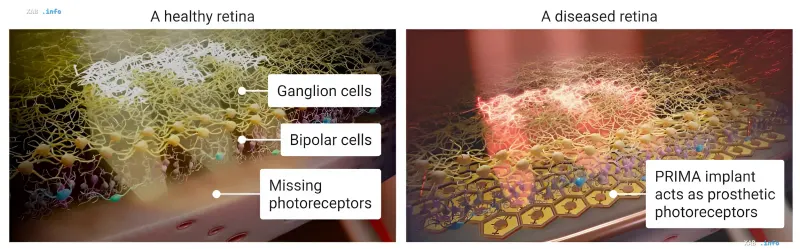
Science Corporation, headed by Neuralink co-founder Max Hodak, has achieved a breakthrough in neurotechnology and ophthalmology. Specialists successfully implanted the Prima subretinal photovoltaic microchip into the first patient suffering from Stargardt disease. This inherited genetic condition inevitably leads to the destruction of central vision and has long been considered medically incurable, leaving patients with little hope of maintaining independence.
Technological Breakthrough and Chip Operation
The surgical procedure itself was performed back in May at the Sydney Eye Hospital as part of ongoing clinical trials. The innovative system consists of a microchip measuring just 2 by 2 millimeters, surgically placed at the back of the eyeball in the area of dead photoreceptors, and specialized glasses with a built-in camera. The camera captures the surrounding environment and projects an infrared image directly onto the implant, replacing dead natural light-sensitive retinal cells.
First Results and Perception Features
The rehabilitation period yielded encouraging results during the initial stages. During the first session, the patient was able to distinguish a single letter, and during the second, they confidently read a whole word. Describing their new vision, Max Hodak characterized it with the metaphor "looking through a straw": the image remains black-and-white for now, but is distinguished by high sharpness and contrast. This allows a person to read text and distinguish several letters simultaneously, fundamentally changing the quality of life for blinding patients.
Prospects and Medical Context
Stargardt disease affects the outer retina of the eye, destroying light-sensitive elements, yet the inner retina, responsible for transmitting nerve impulses to the brain, often remains undamaged. According to statistics, about 150,000 people worldwide suffer from this ailment. It is worth noting that the Prima chip already has commercial approval in Europe for treating geographic atrophy in macular degeneration, but successful application in Stargardt disease opens a new era in ophthalmology.
Development Plans and Alternative Innovations
Science Corporation's immediate plans include developing next-generation chips equipped with an expanded field of view and smaller electrodes to achieve natural visual acuity. According to the company's management, within the next five years, technologies will advance enough to bring artificial vision quality close to normal human clarity. In parallel, the company is developing other interfaces for monitoring brain activity.