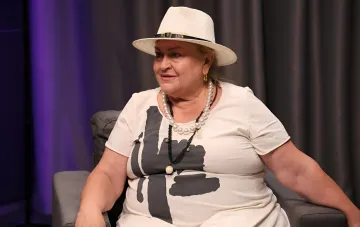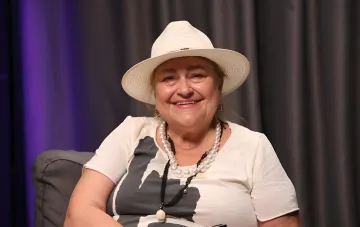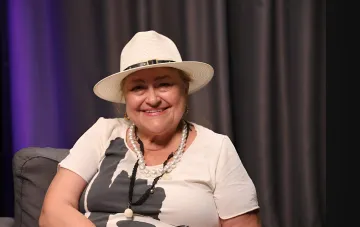
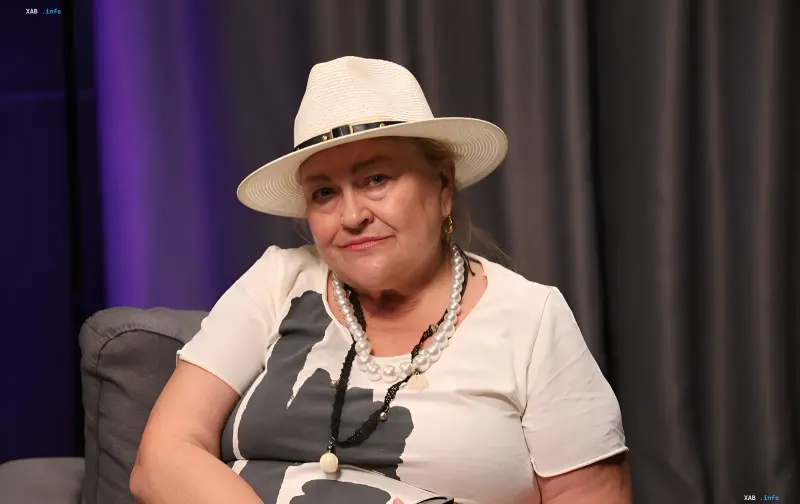
People's Artist of Ukraine Nina Naboka spoke openly in an interview with Wave RBC.UA about the most painful thing for her — the loss of her native land in the Donbas. The actress, who crossed the line between popular comedy and deep dramatic acting in her career, went through difficult trials in her personal life, yet preserved her self-irony and civic stance. In the conversation, she recalled her childhood in Kurakhove, the destruction of her parents' home, and the bombing of the local cemetery, as well as shared a family story and her parents' attitude towards her decision to become an actress.
Childhood on stage: "Ninka-the-actress" from Kurakhove
According to Naboka, she is from the city of Kurakhove in the Donetsk region and "never left the stage" from the age of five: at the club, she was already called "Ninka-the-actress," and the decision to link her life with the theater, in her words, was made "from the very morning I was born." "And it wasn't just my impression, but everyone's," — recalls the actress, emphasizing that there were no problems with choosing a profession. Among pleasant childhood memories, she highlights winning a recitation contest in the Donetsk region in the seventh grade, where, being a "girl from the village," she read a war poem "Ballad of a Song" (in Russian).
Destroyed native land: the pain of losing home and cemetery
The main personal tragedy of the war, Naboka calls the ruin of her native village and the capture of Kurakhove. "I have no parental home, it was smashed. This is the village where my godparents, grandfathers, great-grandfathers, and parents are buried. And even there, at the cemetery, bombs flew," — says the actress. She admits that "nothing makes me happier than thinking about my village," and dreams of sitting on a familiar bench again and meeting those she knows, but for now, it is "scary" and "it won't work out," although she retains hope for a trip.
Ukrainian Donbas: history of the village and native surnames
Answering questions about the origin of the region, Naboka insists on the Ukrainian character of her village, which, according to her, is more than three hundred years old. "Russians came to us after the 30s," — she notes, listing the native surnames on the father's side, where her great-great-grandfathers still lived: Soroka, Naboka, Prytula, Chumak, Kholod, Moroz. The actress adds that she knows well the history of the settlement of the Donbas: Ukrainian villages neighbored mining towns where people came to work after the 30s, and in the hamlets, according to her memories, "zeks (convicts) swarmed," the children of whom she studied with.
Family: sisters, brother, and parental support
Naboka is the youngest, the fourth child in the family. The eldest sister, Valentina Petrovna Chepurnaya, 13 years older, graduated from the directing department in Kyiv, headed art circles at the Pioneer House and, according to the actress, "instilled" in her a love for theater; now Valentina lives with her son in Chernivtsi. The second sister, Natasha, two years older, is a "big chess player," who moved to her daughter in New Zealand, where her daughter took her at the beginning of the war. The brother, who graduated from the Voronezh Technological Institute, went "a completely different way." Parents, according to Naboka's memories, reacted wonderfully to her decision to become an actress: "They knew that I was no good at mathematics... Where can I go? Only there." The mother, the only daughter of a dekulakized kulak family, was very educated — before the war she finished 10 grades, while her peers "were still signing with a cross," — and loved to read.
Contradictory data
In the announcement and headline of the material for Wave RBC.UA, a wider range of topics is claimed: shame for colleagues "boasting of a luxurious life during the war," domestic violence experienced in the first marriage, and readiness to go to the front in the first days of hostilities. However, in the provided shortened version of the conversation, fragments on these topics are missing — the text is limited to memories of childhood, the destruction of Kurakhove, the history of the village, and the family. Thus, there is a discrepancy between the promised coverage of the interview and the text actually presented: some of the announced topics are not covered in the shortened excerpt and are available, according to the editorial office, only in the full video on the Wave YouTube channel. In the article of XAB.info publications, we rely exclusively on facts directly contained in the provided interview text.