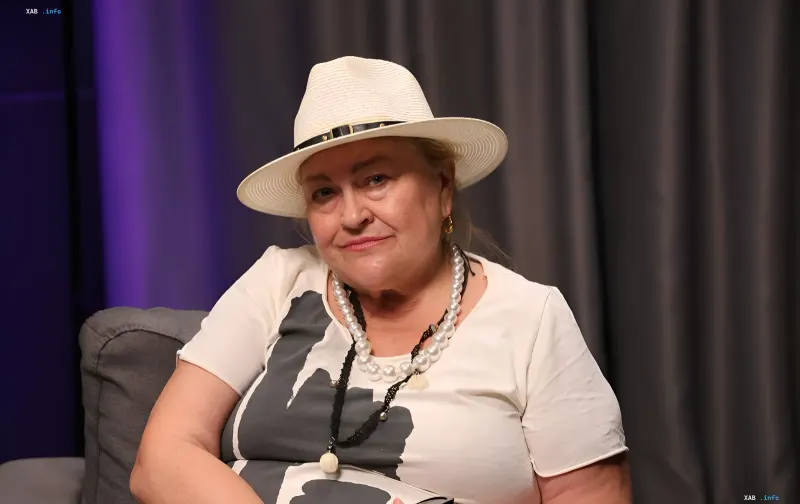
Nina Naboka is an actress who, over decades of her career, crossed the line between popular comedy and deep dramatic acting, while in her personal life she went through heavy trials: the loss of her native home in Donbas, saying goodbye to three husbands, while maintaining self-irony and a civic stance. In an interview for Wave (RBC.UA), she speaks openly about the fact that her greatest pain right now is the destroyed parental home in Kurakhove and the feeling of shame for colleagues who flaunt a luxurious life in the midst of combat operations. Below are key fragments of her story about childhood, war, and family.
Childhood in Kurakhove: on stage since age five
The actress is from the Donetsk region, from the city of Kurakhove. According to her, it is childhood that she remembers as the most precious: "Since childhood, they called me Ninka-the-actress, I performed in the club from the age of five. The decision to become an actress was from the morning when I was born." She emphasizes that from the age of five she "didn't come off the stage," so there were no problems with choosing a profession. From pleasant memories, she highlights her victory at the Donetsk regional poetry reading competition in the seventh grade, where, being a "girl from the village," she read the war poem "Ballad about a Song".
Destroyed home and shelled cemetery
Naboka speaks about the war without embellishment: "They destroyed my village, occupied Kurakhove. There is no parental home of mine, it was destroyed." She clarifies that this is the village where her godparents, grandfathers, great-grandfathers, and parents are buried, and that even at the cemetery "it was hit". "This is a tragedy in life," the actress sums up. She admits that she "has nothing happier than to think about her village," dreams of going there, "sitting on a bench, meeting someone," but for now it is "scary" and "it won't work out anymore," although she retains hope for a trip.
Donbas identity: three hundred years and native surnames
Answering questions about origins, Naboka insists on the Ukrainian character of her village: "Our village is Ukrainian. Russians came to us after the 30s, and our village is already more than 300 years old." She names native surnames on the father's side — Soroka, Naboka, Prytula, Chumak, Kholod, Moroz — and emphasizes that she knows the history of the region well: "There were Ukrainian villages, Russians settled to work in the mines, cities were settled after the 30s... "Zeks" [prisoners] swarmed all the hamlets, I studied with their children. I know well what Donbas is and who was settled there".
Family: sisters, brother, and a mother-reader
Naboka is the youngest, the fourth child in the family. The eldest sister, Valentina Petrovna Chepurnaya, 13 years older, graduated from the directing department in Kyiv, headed art circles in the House of Pioneers and, according to the actress, "instilled in me a love for theater"; now she lives with her son in Chernivtsi. The second sister, Natasha, two years older, is a "big chess player," moved to her daughter in New Zealand and, as Naboka notes, "really wants to go home." The brother graduated from the Voronezh Technological Institute. The parents reacted "wonderfully" to the decision to become an actress, and the mother, according to her, was very educated: she finished 10 grades before the war, was the only daughter of a dekulakized family and "loved reading very much".
Civic stance and pain for colleagues
Along with personal stories, Naboka touches upon a civic topic in the interview: she talks about her readiness to go to the front in the first days of the war, domestic violence in her first marriage, and the loss of three husbands. Separately, the actress expresses "shame for colleagues who flaunt a luxurious life during the war," contrasting their behavior with her own pain of losing her native land. The full version of the conversation is available on the Wave YouTube channel; the text provided is its abbreviated version.
Contradictory data
In the public sphere around the actress, there are several images that do not quite match, which should be taken into account when reading the interview. On the one hand, Naboka emphasizes the Ukrainian identity of her village and deep knowledge of the history of Donbas, but at the same time recalls that in the seventh grade at the regional competition she read a war poem in Russian — an internal nuance of her narrative that can be perceived differently. On the other hand, her sharp criticism of colleagues for "luxurious life during the war" is juxtaposed with other public materials: in one of the publications she showed her dacha near Kyiv, and in another she explained why she lives with a student in a guest house, despite the fact that "we had apartments." These facts do not refute her words about pain and civic stance, but create an ambiguous picture of domestic status, which the editorial board records as a clarification, not as proof of a contradiction in her statements about the war and the loss of home.