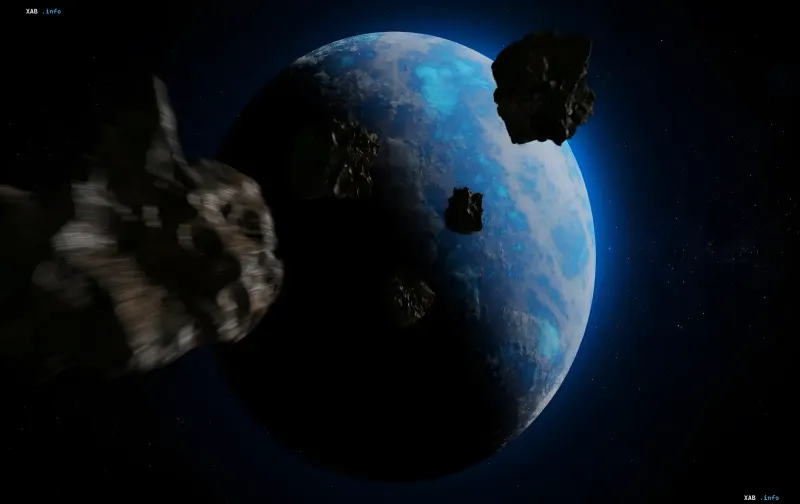
The threat of Earth colliding with large space objects remains one of the most serious potential dangers to humanity. According to official NASA data, up to 15,000 undetected asteroids measuring several hundred meters across may be lurking in near-Earth space, each capable of completely destroying a major city.
Simulation Essence and Threat Scenario
In the event of a sudden discovery of such a cosmic threat, the response window could be just a few days or weeks. Within such a short timeframe, modern civilization is physically unable to organize a large-scale evacuation or build complex interplanetary spacecraft to shift the asteroid's orbit.
Researchers simulated a critical situation where a dangerous asteroid moves toward Earth at a speed of about 10 kilometers per second. Under such extreme conditions, traditional planetary defense methods prove completely ineffective due to severe time constraints.
Nuclear Strike from Within
Instead of detonating a nuclear charge at a safe distance near the object, scientists propose a fundamentally new approach. It involves embedding a powerful nuclear explosive device directly deep into the asteroid's body.
According to the researchers, a powerful internal explosion should completely pulverize the space body into small fragments rather than merely altering its trajectory. The calculations require explosive force significantly exceeding the bomb dropped on Hiroshima in 1945.
Technological Challenges and Prospects
The study's authors openly acknowledge that a massive gap still exists between the computer model and humanity's real technological capabilities. Today, space agencies simply lack specialized spacecraft capable of rapidly drilling into an asteroid's surface.
The current planetary defense standard remains NASA's DART mission, which changed Dimorphos's trajectory in 2022 via kinetic impact. However, this method is only suitable for deflecting objects when plenty of warning time is available.