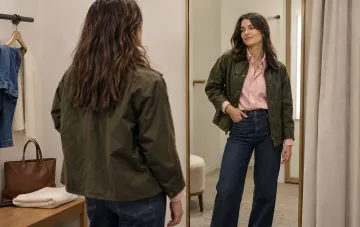

Personal stylist Olga Galushka told the lifestyle project WAVE by RBC-Ukraine in an interview that the familiar concept of a basic wardrobe — a single set of items that “suits everyone” — has effectively become outdated. In her words, a ready-made capsule solves one narrow task: the items in it pair well with one another. But the mere compatibility of clothing items does not, in itself, guarantee that the wardrobe will match a specific person’s lifestyle, appearance, and sense of well-being. “This is really an outdated story with this basic wardrobe and so on. It has transformed into entirely different directions and vectors,” the stylist noted.
Item compatibility is not the same as a suitable wardrobe
Galushka’s key point is that even a thoughtfully curated set of items that pair well with one another can turn out to be a poor fit for the owner if the circumstances in which the clothes will be worn were not taken into account when selecting them. People’s work and personal needs differ substantially: what is appropriate in one context is absurd in another. If these elements are ignored, the capsule remains formally “correct” but is practically useless for a specific person.
What really matters when building a wardrobe
The stylist lists the factors that make the list of items unique for each person: the specifics of one’s figure and appearance, personality, self-image, and the desire to express oneself through clothing. It is precisely the combination of these internal and external characteristics that determines which items will “sit” on a person not only visually but also in terms of how they feel. Asked directly whether this means there is no single list of mandatory items, Galushka answered affirmatively: “This list will be unique. For me it will be one thing, for you it will be another, and for our viewers it will be, for example, radically different, depending on all these factors I just mentioned.”
Contradictory data
It is appropriate here to compare two positions. On the one hand, the classic school of the capsule wardrobe, promoted by many mass publications and guides, offers a relatively standard set of basic items (neutral trousers, shirts, coats, shoes) as a starting point for most people. On the other hand, Galushka’s position is that such a template approach is insufficient: it does not account for individual needs, figure, or personality, so a “universal” list cannot, by definition, be universal. Both viewpoints exist in the public sphere, and the discrepancy between them is not a matter of facts but of methodology: a standardized starting point versus a fully individual build. It is important for the reader to understand that neither side is “wrong” about figures or dates — the issue is one of differing depth of personalization.
Conclusion
The stylist’s conclusion can be stated simply: a wardrobe should be built not from someone else’s list, but starting from one’s own life, figure, and goals. Item compatibility is a necessary but not sufficient condition. Until these two levels align, even the most “correct” capsule will remain a set of items that look good on a hanger but do not meet the needs of the person wearing them.