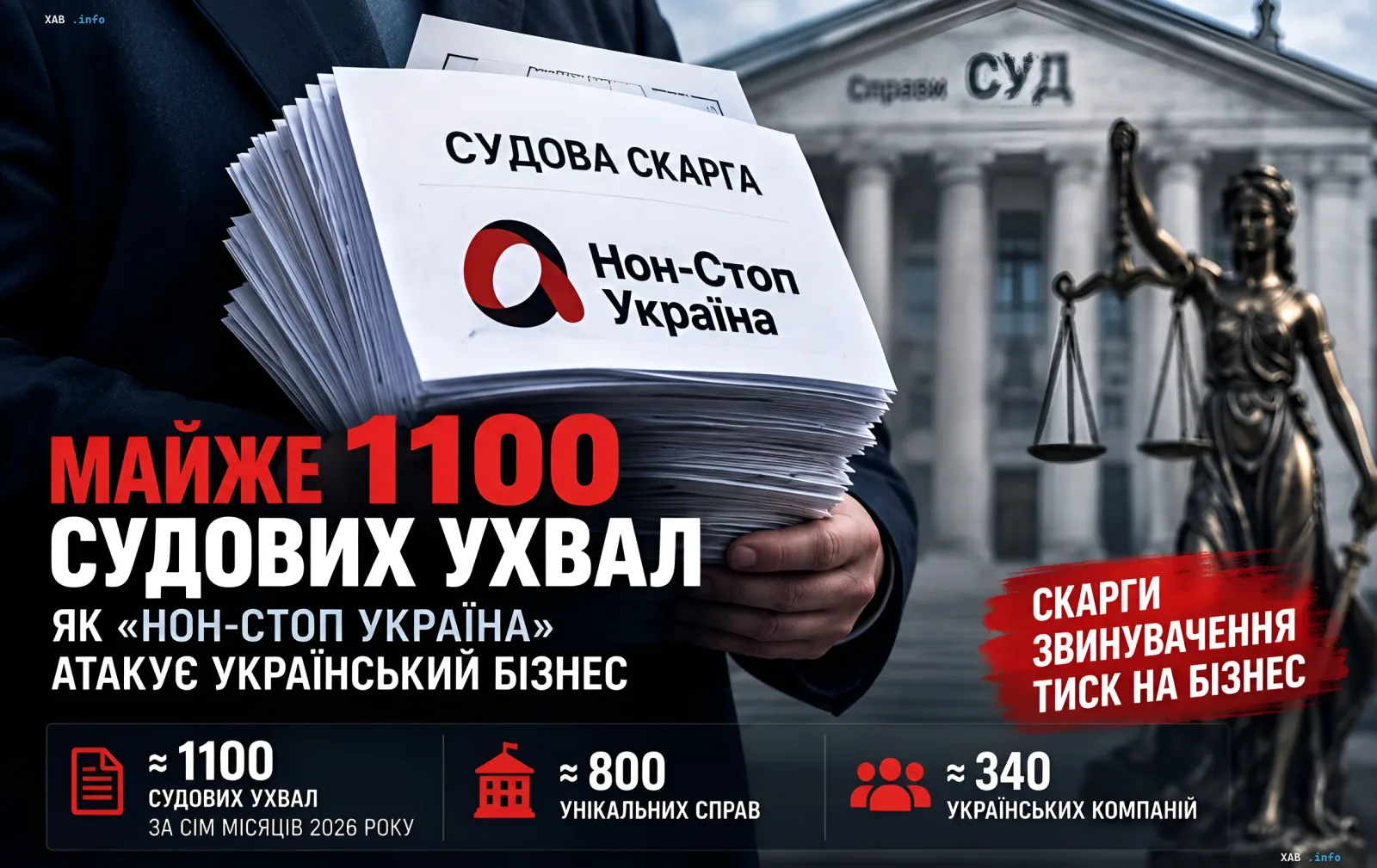
An investigation by Forbes Ukraine, published in September 2026 and reprinted by RBC-Ukraine, documented the unprecedented scale of court filings initiated by the public organization 'Non-Stop Ukraine.' Over seven months of 2026, the organization's name appeared in nearly 1,100 court rulings, which, according to the publication's assessment, corresponds to roughly 800 separate cases and affects around 340 Ukrainian companies. This is not a matter of isolated disputes but of a systematic stream of complaints covering virtually all key sectors of the economy — from defense industry and energy to retail, agribusiness, and pharmaceuticals.
Scale: from defense to pharmacies
Among the companies that have come under the organization's scrutiny, Forbes Ukraine names such entities as MHP, OKKO, KAN, 'Ukrainska Bronetekhnika' (Ukrainian Armored Vehicles), 'Apteka 911' (Pharmacy 911), and drone manufacturer Vyriy Industries. This list demonstrates that the court filings are not confined to any single industry segment. According to the investigation, each such complaint generates a court ruling that is recorded in open databases. It is precisely this point, according to the publication's sources, that turns a formal filing into a tool capable of affecting a company's operations long before any guilty verdict.
Compliance, banks, and tenders: how a complaint hits business
Forbes Ukraine's sources explain that the problem goes far beyond the mere fact of filing a complaint. Once court rulings appear in open databases, the information automatically enters counterparty screening systems used by banks, corporate clients, and state purchasers. As a result, companies have to spend time and resources explaining to partners why they are mentioned in case materials with serious accusations. One top manager told the publication that his company spent months doing explanatory work with counterparties. Other market participants noted that such an information backdrop complicates banking compliance, hinders obtaining loans, opening accounts abroad, and participating in tender procedures.
Information pressure: 20 posts a day
In parallel with its court activity, 'Non-Stop Ukraine' runs an intensive operation in the information space. According to Forbes, the organization's Facebook page and Telegram channel publish an average of about 20 messages per day. Moreover, 76% of the companies named in court complaints also appear in the channel's posts. In experts' view, this combination — a court filing plus a public media campaign — creates a cumulative effect: even if the complaint is later dismissed, the reputational damage has already been done, and the information remains in search results and databases.
Contradictory data
Part of the investigation concerns the possible commercial motives behind certain information campaigns. One business representative told Forbes that he had received, through an intermediary, an offer to stop the information pressure in exchange for money. However, the journalists explicitly stress that they were unable to document the intermediary's direct link to the public organization or the amounts mentioned. 'Non-Stop Ukraine' itself, in its response to Forbes's request, categorically denies extortion, stating that it does not receive money for filing complaints and has not demanded payment for stopping filings or publications. Thus, the version of a commercial nature of the pressure remains at the level of isolated testimony without documentary confirmation, while the organization's version stands at the level of an official denial. Neither side has provided conclusive evidence, and the question remains open.
Court protection and a systemic issue
Some companies have already begun to defend their business reputation through the courts. Forbes cites the examples of Cofco, SkyUp, and Ukrenergomashyny JSC, which obtained a court finding that certain information was false, with the next step being its refutation. Nevertheless, experts stress that a court refutation does not undo the reputational damage already inflicted and does not remove the records from databases. The story around 'Non-Stop Ukraine' goes beyond individual court disputes and raises a systemic question: how mass filings with law enforcement bodies, combined with the public dissemination of accusations, affect companies' reputations and operational resilience even before the validity of those accusations is established by a court.