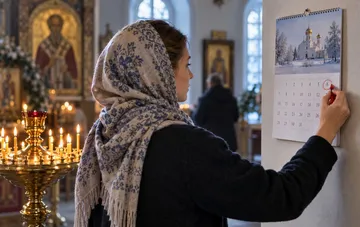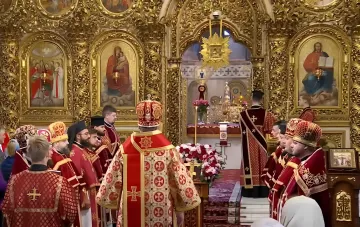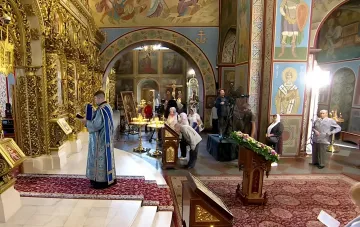
According to the current church calendar, on November 13 the Orthodox Church of Ukraine (OCU) honors the memory of one of the greatest teachers of Christianity and prominent thinkers of the early Church — Saint John Chrysostom, Archbishop of Constantinople. This was reported by RBC-Ukraine, referencing a publication by the OCU press service on Facebook. It was John Chrysostom who composed the order of the Divine Liturgy, which bears his name to this day and is most frequently celebrated in churches.
From Noble Antioch Lawyer to Monasticism
John Chrysostom originated from Antioch — the then-capital of Syria and one of the main cities of the Roman Empire. He was born into a noble family and received a brilliant, versatile education and Christian upbringing. Initially, he worked as a lawyer for a certain period, but later embraced monasticism and the priesthood. According to the OCU, he was prompted to take this step by his childhood friend Basil, who had taken monasticism before John and is now venerated as Saint Basil the Great. To know God more deeply, John thoroughly studied the Holy Scriptures, prayed sincerely, disciplined his body, and lived in seclusion. Returning to his native Antioch, he was ordained a deacon, and later a presbyter.
A Preacher Whom Nobody Wanted on the Patriarchal Throne
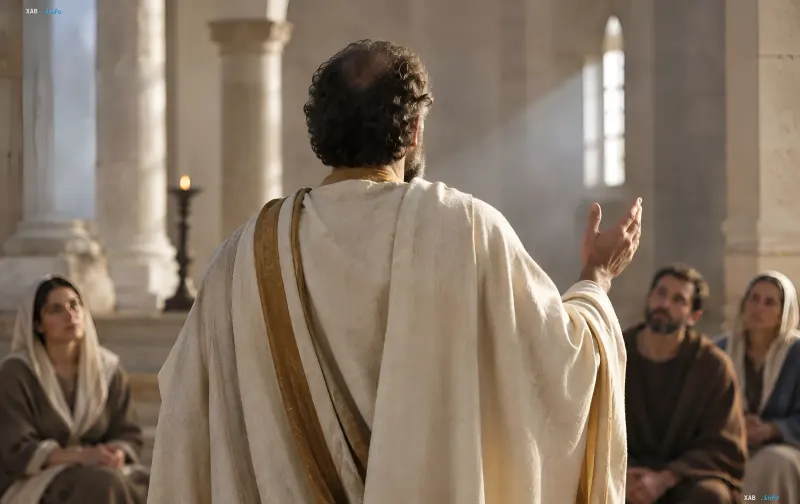
Among his compatriots, John quickly gained great respect as a preacher and church orator. His convincing, inspiring, and instructive word comforted listeners; contemporaries called him an unsurpassed and wise teacher of Christian science. In 398, at the Church of Hagia Sophia in Constantinople, he was ordained as archbishop to the See of Constantinople. At the same time, as the OCU emphasizes, the saint himself did not desire this promotion and did not want to part with his homeland. Knowing this, the dignitaries of Emperor Arcadian, who sought to see an outstanding orator on the patriarchal throne, lured John out of the city under the pretext of visiting holy places, placed him in a chariot, and brought him to the capital against his will, where Arcadius personally announced his will in the crimson chamber of the imperial palace.
Denunciation of Vices and the Path to Exile
John Chrysostom began his rule on the supreme church throne of the empire with radical steps prompted by his love for an ascetic lifestyle. First and foremost, he cared about helping people and saving their souls, rejecting and denouncing the vices of contemporary society. As a result, the authorities, the wealthy part of the imperial capital, and a section of the clergy did not approve of such activities. Not far from Constantinople, the dissatisfied organized a council against him, which under a far-fetched pretext deprived the saint of his cathedra and rank. He was declared a heretic, a sorcerer, and a villain, excommunicated from the Church, and exiled to the edge of the empire to isolate his fiery, God-inspired word — "the most terrible weapon against lawbreakers," according to the OCU's formulation.
Death in Comana and Theological Heritage
In the distant city of Comana, while in exile, John Chrysostom died in September 407. According to tradition, his last words were: "Glory to God for all things!". The saint left behind a theological heritage comparable in volume only to the works of a few Church Fathers. His works were highly valued as early as the 5th century, including during the Council of Chalcedon. According to the Greek Horologion, 1,447 works of Chrysostom that have survived to our time are counted, as well as 244 letters. Most of all, church homilies and sermons have been preserved, striking in their harmony, depth of thought, and variety of content; among his prominent works is his commentary on the Holy Scriptures.
The OCU's Call to Prayerful Veneration
In conclusion, the OCU press service urged believers to honor with heartfelt prayer "the great teacher of Christianity, the inspiring preacher, the true healer of human souls" and to take to heart his life example, unbreakable faith, and hope in God, addressing him with the words: "Saint Father John Chrysostom, pray to God for us."