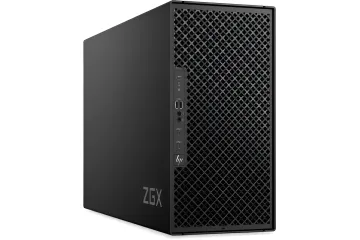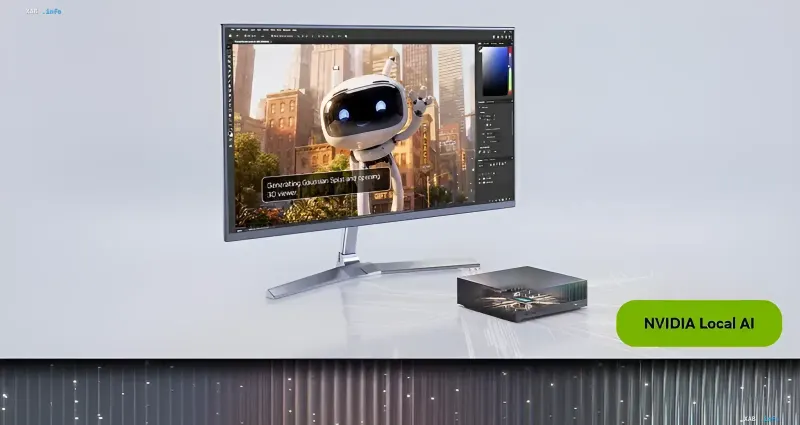
On November 18, 2026, Nvidia officially announced the launch of sales for the RTX Spark series of compact desktop computers, developed in partnership with Asus, Dell, and MSI. The devices run on Windows on Arm and are designed to perform artificial intelligence tasks locally on the user's side—without the mandatory use of cloud services. The lineup includes the Asus ProArt GR1X and MSI EdgeMesa N AI+ models, which are positioned as specialized workstations for developing AI solutions and continuously running AI agents. In addition to the first three manufacturers, Acer, Gigabyte, HP, and Microsoft are preparing similar systems on the same platform, with the latter introducing a device called the Surface RTX Spark Dev Box.
Hardware: Grace, Blackwell, and 128 GB of Unified Memory
At the core of each RTX Spark mini-PC is a 20-core Nvidia Grace processor paired with a Blackwell architecture graphics processor featuring 6,144 CUDA cores. According to Nvidia, the systems support up to 128 GB of unified memory and deliver AI performance levels of up to 1 petaflop. A 10-gigabit network connection is provided to transfer large datasets and model files between local storage and network devices. This set of specifications allows the devices to compete with full-scale server configurations in the narrow segment of local AI inference.
Local AI: Models Up to 120 Billion Parameters and Real-Time Rendering
According to Nvidia, RTX Spark systems are capable of locally running large language models containing up to 120 billion parameters, as well as performing image and video generation, AI agent operation, and model fine-tuning. In addition, real-time rendering of 3D scenes exceeding 90 GB in size and lossless 4:2:2 video editing are supported. Developers have access to CUDA tools and a Linux environment via the Windows Subsystem for Linux (WSL). Nvidia is also expanding support for the Hermes Agent platform and its NemoClaw templates, while integration with the Unsloth tool is provided for model fine-tuning. Special attention is drawn to the Nvidia Switchyard technology, which allows AI agents to dynamically distribute tasks between local and cloud models depending on the current workload.
Adobe, Blender, and ComfyUI: Creative Stack Updates for Arm
Alongside the hardware platform, Nvidia announced a series of software updates for creative tasks. In Adobe Premiere Pro, TensorRT-RTX acceleration is now applied to Enhance Speech, Object Mask, Scene Edit Detection, and Auto Reframe features; according to Nvidia, the updated workflow reduces H.264 video preparation time by more than 50%. In Adobe Photoshop, TensorRT-RTX acceleration is utilized in the Remove Tool, while native Camera Raw support is implemented on RTX Spark systems. Adobe Substance 3D Painter 12.2 has entered public beta with native Arm architecture support, and optimized builds for Windows on Arm have been released for Illustrator and InDesign—Illustrator's performance in this mode increases by up to 30% compared to the emulation version. Blender 5.3 introduces DLSS 4.5 Ray Reconstruction support for the viewport in the Cycles engine, allowing ray-traced lighting and materials to be seen during editing with a noticeable reduction in noise levels. ComfyUI capabilities have been expanded with RTX Video Frame Generation and RTX Video HDR technologies, enabling video conversion to 60 frames per second and HDR processing directly within the generation environment.
Pricing and Market Availability
The Asus ProArt GR1X, Dell, and MSI EdgeMesa N AI+ models went on sale on November 18, 2026. The recommended price starts at $4,399 USD. Specific pricing for individual configurations was not provided in Nvidia's announcement. Systems from Acer, Gigabyte, and HP, as well as Microsoft's Surface RTX Spark Dev Box, are expected later in 2026. Thus, Nvidia is effectively forming a new segment of desktop AI workstations targeted at developers, content creators, and teams for whom local data processing without dependence on cloud infrastructure is critical.