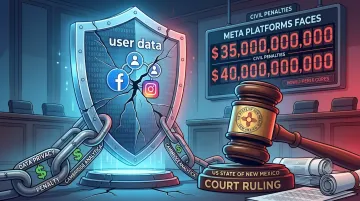
A court in the state of New Mexico has issued an unprecedented ruling against the tech giant Meta✴. The company is required to pay $567 million into a special fund for teen mental health protection and radically change the operating mechanisms of its platforms — Facebook✴ and Instagram✴. The court found the corporation guilty of creating a public nuisance, stating that the company's products cause addiction in minors and harm their well-being.
History of the lawsuit and previous fines
This ruling marks the culmination of a long legal battle initiated by the New Mexico Attorney General. Previously, in March 2026, a jury had already ordered Meta to pay $375 million, finding the company guilty of violating consumer protection laws and misleading the public regarding the safety of its services. Thus, the total financial damage inflicted on Meta in this case approaches one billion dollars. The judge ruled that the company created a "public nuisance," which allowed the prosecution to demand not only fines but also structural changes in the operation of algorithms.
New restrictions and safety measures
The court order, which will be in effect for five years, includes a number of strict requirements. Meta is required to implement monthly usage limits for teens on its platforms, limit the number of notifications to reduce intrusiveness, and tighten control over contacts between adults and minor users. Additionally, the company must implement protective measures for AI chatbots and begin automatically scanning messages for materials related to child abuse. The judge emphasized that the harmful impact of the platforms extends beyond the internet, creating a social burden for families, schools, and law enforcement agencies.
Contradictory data
The parties involved present diametrically opposite points of view regarding the nature of the accusations and the feasibility of their implementation. Meta✴ representatives insist that the company cannot be held responsible for content posted by users, citing US federal legislation. They also argue that many of New Mexico's requirements are "technologically impractical or completely impossible" to implement. The company emphasizes that Meta social networks are not the only apps used by teens, and the influence of other platforms is ignored in the lawsuit.
On the other hand, the judge rejected Meta's arguments, pointing out that the state's claims concern the functions of the platforms (algorithms and architecture), not liability for third-party content. The state Attorney General stated that the ruling is the first to force a social media giant to make real changes, calling it a "roadmap" for other states and countries. However, the judge refused to approve some of the prosecution's measures, such as banning infinite scrolling, considering them a potential violation of the company's rights enshrined in the US Constitution.
Company reaction and prospects
Meta✴ has announced its intention to appeal this ruling. In a company statement, it said: "We remain confident in our work to protect teens online and will continue to defend against fact-distorting claims." The corporation emphasizes that it is already working on identifying and removing harmful content. However, the New Mexico Attorney General insists that Meta chose profit over children's safety. This ruling could set a precedent for social media regulation on a global scale, establishing standards that could be adopted in other jurisdictions.