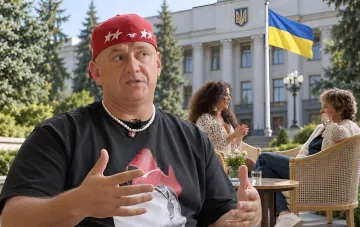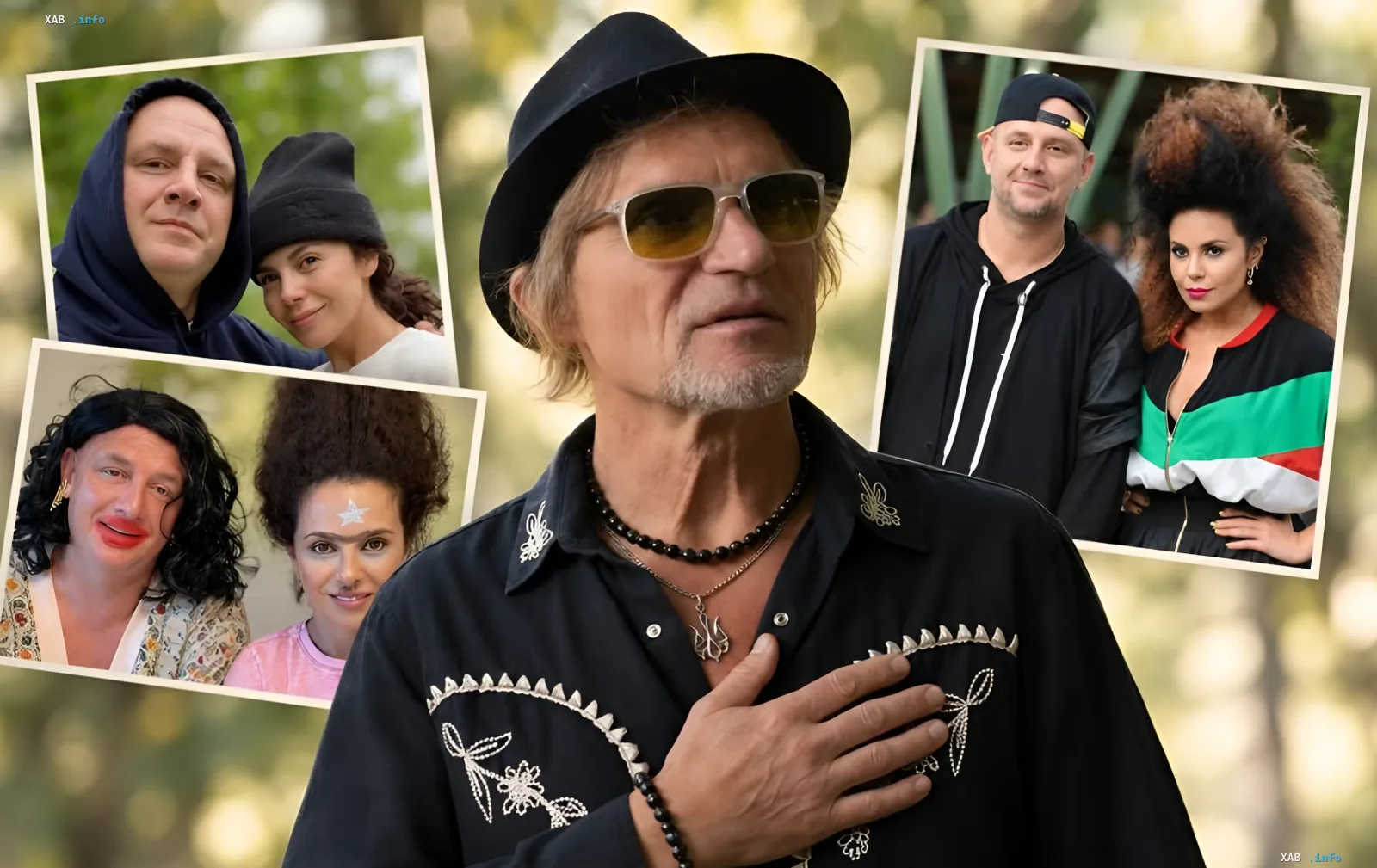
Oleh Skrypka, the leader of the band 'Vopli Vidoplyasova,' made a pointed statement about Ukrainians who today live outside the country, as well as about artists who target this audience. The musician linked the phenomenon primarily to the language issue, claiming that a portion of compatriots abroad still remain within a Russian-speaking environment. In his words, it is precisely such listeners, as he believes, who can become a 'profitable audience' for performers building their careers outside Ukraine — above all for Potap and Nastya Kamensky.
'That's the Soviet Union There': Skrypka's Argumentation
In the conversation, Skrypka attempted to 'examine the situation' and explained his position as follows: Ukrainians abroad, in his view, are 'less Ukrainian than those here,' because overseas they find themselves surrounded by a Russian-speaking community — 'Georgians with the Baltics, with Belarusians, with Russians' — who, according to him, 'are all good, all wish well' and speak Russian. 'And that is precisely Potap and Nastya's audience, and they are fighting for it, and this audience is more profitable for them than the Ukrainian one,' the musician stated, adding that if Ukrainian listeners at home 'did not accept' such artists, then abroad they 'will sink into this audience like into a warm bath.'
Potap's Reaction and the Context of Kamensky
The statement quickly drew a response from the very party mentioned. According to several publications, Potap reacted to Skrypka's words ironically — including by proposing to introduce some kind of 'Ukrainometer' to measure the 'degree of Ukrainianness,' which effectively amounted to public trolling directed at the musician. Against this backdrop, the day before, singer Nastya Kamensky publicly reacted for the first time to the wave of criticism that arose after her resonant interview with Katerina Gordeeva, in which she spoke about switching to the Ukrainian language after the start of the full-scale invasion and about voice problems she linked to that period.
'The Truth Is Disgusting Content': Kamensky's Position
In the published video, Kamensky reflected on honesty, audience reaction, and the desire to please others, stating that she is not going to change her words simply because they provoked negativity. 'The truth is disgusting content and bad storytelling. It goes against the laws of show business. Never tell the truth about yourself if your goal is to 'be liked.' But if you don't care, then that is the only way to remain a human being in 2026,' the artist said. She also emphasized that she does not want to become a hostage to the public's expectations, adding: 'The ideal hero for any society is a dead person. He does not change, does not make mistakes, and is never inconvenient.'
Contradictory Data
Fact-checking revealed discrepancies in how exactly Skrypka's statement was conveyed across different publications. In one piece, his words are quoted as 'Ukrainians abroad are less Ukrainian than those here,' while in another headline the same idea is formulated as 'they are not real Ukrainians,' with the episode presented as an 'insult to Ukrainian refugees abroad.' In other words, some editors interpret the musician's words as a value judgment about the language environment, while others — as a direct devaluation of refugees' status. Moreover, sources describe Potap's reaction differently: from an ironic 'Ukrainometer' to a 'sharp response.' These inconsistencies in wording and in the interpretation of the statement's tone make the picture ambiguous, although the fact of Skrypka's public statement itself is confirmed by several independent publications.
Evaluative Nature and the Boundaries of the Debate
It should be noted that, under Ukrainian law, Skrypka's statements, as well as Kamensky's responses, fall into the category of value judgments, which cannot be refuted or have their 'truth' proven. Nevertheless, the topic turned out to be sensitive: it touches on millions of Ukrainian refugees, the question of language and audience loyalty, and a public conflict between representatives of the music industry. The debate that flared up around these words has effectively gone beyond the discussion of a single interview and turned into a dispute over who and how defines the 'Ukrainianness' of compatriots abroad.